
Alberta Premier Danielle Smith got nearly all of the results she wanted from the Oct. 19 referendum, but she now faces constitutional and practical hurdles to carrying out the changes voters endorsed.
Preliminary results as of the evening of Oct. 20, with 90 percent of voting locations reporting, showed that a majority of Albertans voted “Yes” on eight of the nine questions aimed at giving Alberta more control over immigration and provincial services, as well as pursuing various constitutional changes. As votes on some proposals, particularly those related to constitutional reform, are close, some results could change as votes from all locations are counted.
“We will be pursuing the reforms approved by Albertans through this referendum in the coming months and years ahead,” Smith said in a televised address on Oct. 20.
All five policy reforms received majority support, preliminary results show. They included giving Alberta more control over provincial immigration, restricting access to provincially funded services for certain temporary residents, requiring a minimum residency period to receive social assistance, charging temporary residents “a reasonable fee or premium” for health care and education, and requiring proof of Canadian citizenship to vote in provincial elections.
The constitutional reforms that passed according to preliminary results include abolishing the Senate, prioritizing provincial laws over federal laws in areas where they overlap and conflict, and giving Alberta a greater say in appointing judges, although the vote on the latter is very close and could change as more ballots are counted.
‘I Don’t Think It Will Be Easy’
Tom Flanagan, professor emeritus of political science at the University of Calgary and a former campaign manager for former Prime Minister Stephen Harper, said many of the measures will be hard to implement, and may come at political cost, or counter-measures by the federal government.
He cited denying provincially funded health care to certain temporary residents as one example.

The Alberta legislature in Edmonton in a file photo. Carolina Avendano/The Epoch Times
“I don’t think it will be easy, because the subject lends itself to opponents finding sob stories of individuals who seem to be sympathetic, but are being charged for their health care,” he told The Epoch Times.
“It very quickly gets away from immigration and turns into a debate about universality.”
Flanagan added that, while Alberta could move to withdraw provincially funded social assistance, removing health-care access could lead Ottawa to withhold federal funding under the Canada Health Act.
As for the constitutional issues, which historically have proven very challenging to modify, Flanagan said changes to judicial appointments may be the relatively easier of the group to pursue, if the “Yes” vote on it holds as ballot count continues.
“You might be able to negotiate a solution with the federal government in which the province gets to nominate a slate of three or five names,” he said.
Other constitutional questions will be more difficult, and abolishing the Senate “is not going to happen,” he added.
Mario Canseco, head of the polling firm Research Co., highlighted that the results, which were in the 50 to 60 percent range for the policy questions and hovering around 50 percent for constitutional reforms, weren’t overwhelming to one direction, saying it adds to the challenge of Smith pursing them.
Canseco said rejection of question 8, which proposed allowing Alberta to opt out of some federal health-care, education, and social assistance programs and provide its own versions, likely irked some older voters.
“How is this going to affect my pension? How is this going to affect a bunch of things that I want to do?” he said, laying out the likely concerns of some older voters.
Prime Minister Mark Carney, who has opposed the changes sought by the referendum questions, said one day after the vote that he has spoken with Smith and they have agreed to move forward “in the spirit of cooperative federalism” on the issues.
Path Forward
Marco Navarro-Génie, president of the Haultain Research Institute and vice-president of research and policy at the Frontier Centre for Public Policy, said he expects Smith’s government to move first on measures that can be put into effect without needing a green light from Ottawa.
“I suspect that question 5 is going to be the first one that they’re just going to table a bill and fly it through,” he said in an interview, referring to the requirement that proof of Canadian citizenship be provided before voting.
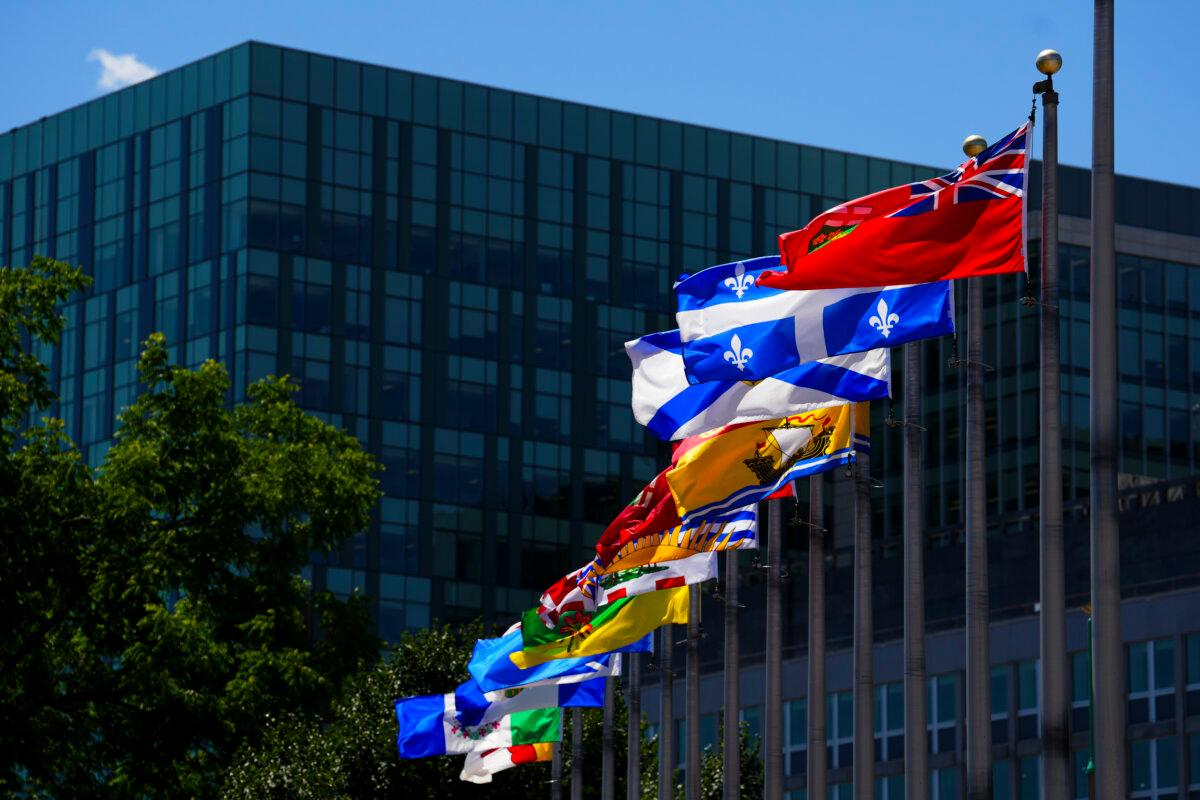
Canada's provincial and territorial flags blow in the wind in downtown Ottawa in a file photo. The Canadian Press/Sean Kilpatrick
University of Calgary economics professor Trevor Tombe said the government could move relatively quickly on some measures involving fees, premiums, or residency requirements.
“To the extent that some are implementable by the government itself, like fees, that sort of thing, or residency requirements, that could be something that we see in the budget,” he told The Epoch Times, referring to Alberta’s upcoming February budget.
Ian Brodie, a University of Calgary political science professor and former chief of staff to Harper, says there is a real possibility that Smith could build a coalition with other provinces to pursue constitutional reforms.
He said Alberta’s last referendum held in 2021 under former Premier Jason Kenney, which gave the province a mandate to seek a constitutional change to abolish the equalization formula, didn’t have a chance of success because it pitted Alberta against the other provinces that benefit from the program. But he said the proposed constitutional changes this time around will more likely get the support of other provinces.
“I think there’s certainly a viable coalition for a constitutional change,” he previously told The Epoch Times.
Most constitutional amendments in Canada require approval from the federal Parliament and at least seven provinces representing at least 50 percent of the country’s population. Abolishing the Senate, however, would require federal parliamentary approval and the consent of all provinces, and provinces such as Prince Edward Island who have more representation in the Senate than more populous provinces such as Alberta have historically been opposed to changes in the composition.
Smith said on Oct. 20 that Alberta is waiting for confirmation of official results from Elections Alberta and will then move to “pursue more provincial autonomy over the selection of judges, to abolish the unelected federal senate, and to better protect our provincial rights.”
She previously said that while abolishing the Senate would be the hardest to accomplish, she believes constitutional change is possible, particularly given the many conservative premiers currently leading provinces.
“We’re at a moment in time where we probably could get constitutional change in a way that we haven’t been able to,” she told The Epoch Times on Oct. 16 in Calgary. “If we can identify some of these core issues that we can agree on together,” then “I think we can make some change.”
Political Ramifications
There has been continued opposition to Smith’s leadership of the United Conservative Party (UCP) by some pro-separatist elements within her party due to her stance on independence.
Independence organizer Jeffrey Rath has called for replacing Smith, saying independence won’t be achieved while she leads the province. He said he will hold a special party meeting to oust her.
Party members will be voting on her leadership during their November general meeting. Smith received a support of 91.4 percent in the last leadership review in 2024.

A delegate arrives at the United Conservative Party annual general meeting in Calgary on Nov. 3, 2023. The Canadian Press/Jeff McIntosh
Smith urged UCP members on Oct. 21 to now turn their attention on the campaign against the NDP, as 2027 is an election year in the province, saying that those who can’t move on from the issue of separation and are “sowing division” should leave the UCP, as the party is not separatist.
Navarro-Génie says Smiths pursuit of the other changes through the other referendum questions will help her politically, to show she is standing up for the province.
“[Former Alberta Premier] Ralph Klein made an entire career out of either punching at the feds or appearing to punch at the feds. It’s a winning formula in Alberta,” he said. “All that says is that the premier has pretty good political antenna.”
“If you want to succeed in provincial politics, it doesn’t matter what province you are, you’ve got to be seen to stand up to the feds,” Navarro-Génie added.
Flanagan, however, said it remains unclear whether progress on the policy and constitutional changes approved in the referendum will unify Smith’s UCP base and settle separatists within the party.
“I think she may have been hoping that this would placate that sovereigntist element. Now, will it? I don’t know,” Flanagan said, adding that support for separation is much higher among UCP members than among the public overall.
Flanagan said Smith’s challenge going forward is to keep her party united while keeping the support of Albertans.
“I’m sure that Danielle is looking over her shoulder, and she’s got a delicate dance to perform to try and keep the public satisfied, but keep her own party satisfied,” he said.
Smith will also continue facing challenges in the major cities. In the last election, the majority of Edmontonians voted for the NDP, while rural Alberta backed Smith’s UCP, and the vote was more divided in Calgary.
On the referendum, there was a clear divide on support for the changes Smith sought among the Edmonton and Calgary voters versus those outside, with almost all proposals being rejected by the residents of the major cities except the one asking for proof of citizenship for voting, which barely exceeded the 50 percent mark. Those outside of the two major cities voted for all of Smith’s proposals.
Tombe said the rural-urban divide has been a long-standing feature of Alberta politics.
Smith, meanwhile, has pledged not to hold another separation referendum during her tenure, and has said any future conflicts with Ottawa will be settled within Confederation.
“We will use every legal and political tool at our disposal to protect and advance the interests of Albertans. And when Ottawa interferes with those rights, we will be unrelenting in our response,” she said.
“But those disputes will be settled within the political and legal institutions of our nation, rather than pursuing the option of separation.”







 English (US) ·
 Turkish (TR) ·
