
 3 hours ago
21
3 hours ago
21
More warships will be equipped to fire the supersonic cruise missiles developed and produced by an India-Russia joint venture
India has contracted for more BrahMos missile launchers and fire-control systems for its Navy warships, expanding deployment of its primary maritime-strike weapon across the fleet.
The Defense Ministry signed the roughly $69 million contract with BrahMos Aerospace Private Limited in New Delhi on Tuesday. The order covers fire-control systems and launchers for Indian Navy ships and was made under a scheme to buy items that are indigenously designed and manufactured.
Several frontline Indian warships including destroyers and frigates already are armed with BrahMos missiles. New ships commissioned in recent years have received the system as standard equipment, while older vessels are being retrofitted in phases as part of a wider push to expand BrahMos deployment across the fleet by 2030, reports said.
BrahMos can be launched vertically or at an incline from naval platforms and is capable of striking both ships and land targets at extended ranges at supersonic speed.
The Indian Navy has operated BrahMos since 2005, when its anti-ship variant was integrated onto Rajput-class destroyers. The system has since become the service’s principal surface-to-surface weapon.
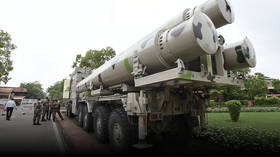
The latest purchase follows much larger contracts signed in 2024 when the missiles were ordered for the Navy’s combat and training requirements, along with additional shipborne BrahMos systems.
BrahMos Aerospace is a joint venture between India’s Defense Research and Development Organization and Russia’s NPO Mashinostroyenia. The program has produced ship-, land-, and air-launched versions of the supersonic cruise missile.
The new project will have at least 68% indigenous content and involve Indian companies, including micro, small, and medium enterprises. The ministry said the program is expected to generate employment over three years while increasing domestic participation in advanced military technology.










 English (US) ·
  Turkish (TR) ·