
 2 hours ago
23
Politics·New
The secretary of state in charge of the Canada Revenue Agency is defending the CRA's decision to award a $12-million security contract to a Canadian subsidiary of an American multinational company over the Commissionaires.
The difference between the two bids was less than one per cent of its value, says Commissionaires spokesperson

Kate McKenna · CBC News
· Posted: Oct 20, 2026 5:21 PM EDT | Last Updated: 7 minutes ago

Listen to this article
Estimated 3 minutes
The audio version of this article is generated by AI-based technology. Mispronunciations can occur. We are working with our partners to continually review and improve the results.

The secretary of state in charge of the Canada Revenue Agency is defending the CRA's decision to award a $12-million security contract to a Canadian subsidiary of an American multinational company over the Commissionaires.
Founded in 1925, Commissionaires is a private, not-for-profit security organization that was founded to provide meaningful employment to veterans of the Canadian Armed Forces and police services.
Publicly available documents show that in June 2026, the CRA awarded the contract to Universal Protection Service of Canada Corporation, a subsidiary of Allied Universal Security Services — a security company with ties to the U.S. Immigration and Customs Enforcement (ICE) deportation program.
It comes months after Commissionaires said the federal government told them they will no longer have first right of refusal for most federal contracts.
"When we initially spoke with government back [in February], we were told, well, you're not going to get the right of first refusal, but we still want to support your organization," said Geoff Hamilton, president and CEO of Commissionaires Great Lakes.
The CRA contract was an outlier in that it was always a competitive bid, but the Commissionaires held the contract until the recent tender.
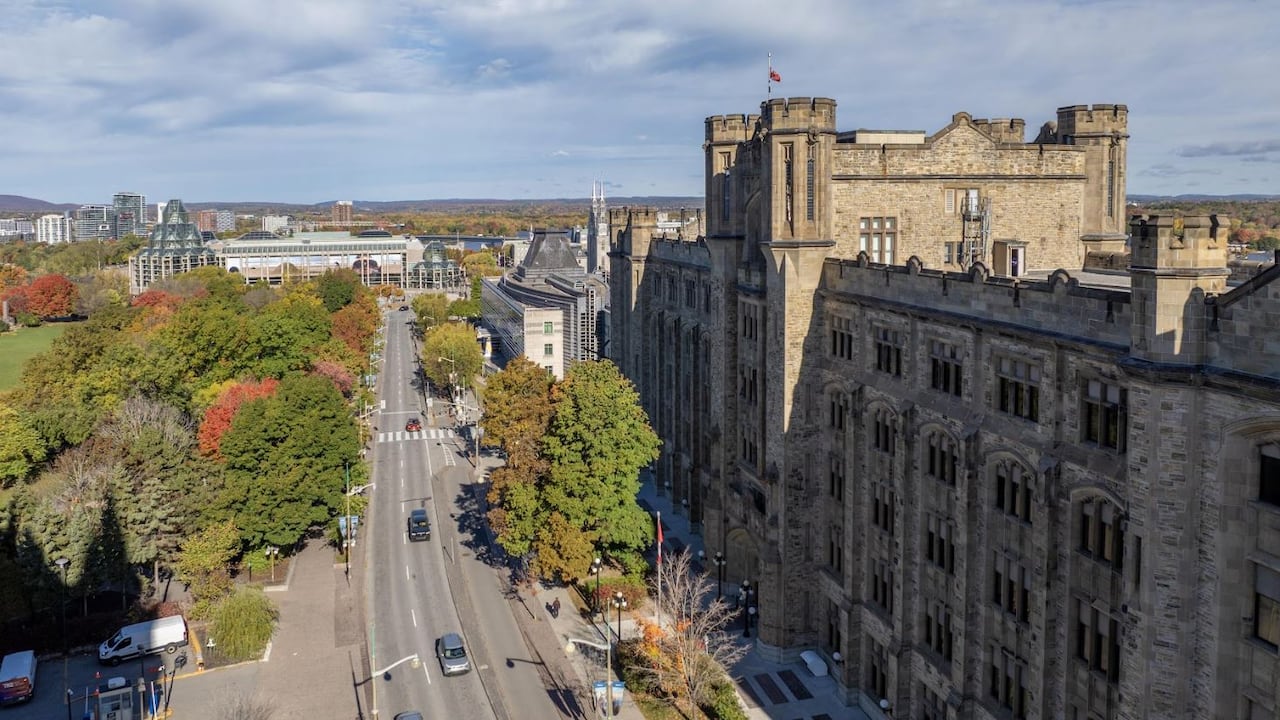
Aerial view of the Connaught Building, the Canada Revenue Agency's headquarters in Ottawa. (Félix Desroches/Radio-Canada)
Hamilton said the difference in bid was $80,000, representing less than one per cent of the contract's value.
"It is just sort of public sector procurement on autopilot," said Hamilton.
Opposition blasts government over decision
Conservative veterans affairs critic Michael Barrett raised the issue in question period on Tuesday.
"We can all agree that employing Canadian veterans and hiring Canadian companies is important. The question to the Liberals is why didn't they do that in this case?"
Wayne Long, secretary of state for the CRA, both defended the process and argued that cabinet wasn't involved in the decision to go with the private company.
"The process resulted in the selection of a qualified Canadian supplier," Long said in response to Barrett.
"The member knows politicians are never involved in the independent decisions by the CRA."
NDP MP Gord Johns also blasted the decision to award the contract to a private company rather than the Commissionaires.
"Canadians want to know, how does awarding this contract to a foreign owned corporation with those ties [to ICE] instead of a Canadian owned institution supporting veterans square with the Liberals' Canadian promises," Johns said in the House during a debate on military procurement.
In a statement, Allied Universal said it is a registered Canadian company with 10,100 employees and 19 offices across Canada. It said the company's relationship with the U.S. government has existed for several administrations and spans federal agencies.
A spokesperson for Long added in a statement that the CRA's evaluation criteria consider more than overall cost, and can include, among other things, past performance on similar contracts, business continuity planning and ability to recruit and deploy personnel.
The statement said the decisions are made independently, without political interference.
ABOUT THE AUTHOR

Kate McKenna is a senior reporter with CBC’s parliamentary bureau in Ottawa, where she covers federal politics. She previously worked for CBC’s The Fifth Estate and in the Halifax, Montreal and Charlottetown newsrooms. Her investigative and breaking news coverage has won five RTDNA awards. She is the author of No Choice: The 30-Year Fight for Abortion on Prince Edward Island.







 English (US) ·
 Turkish (TR) ·
