
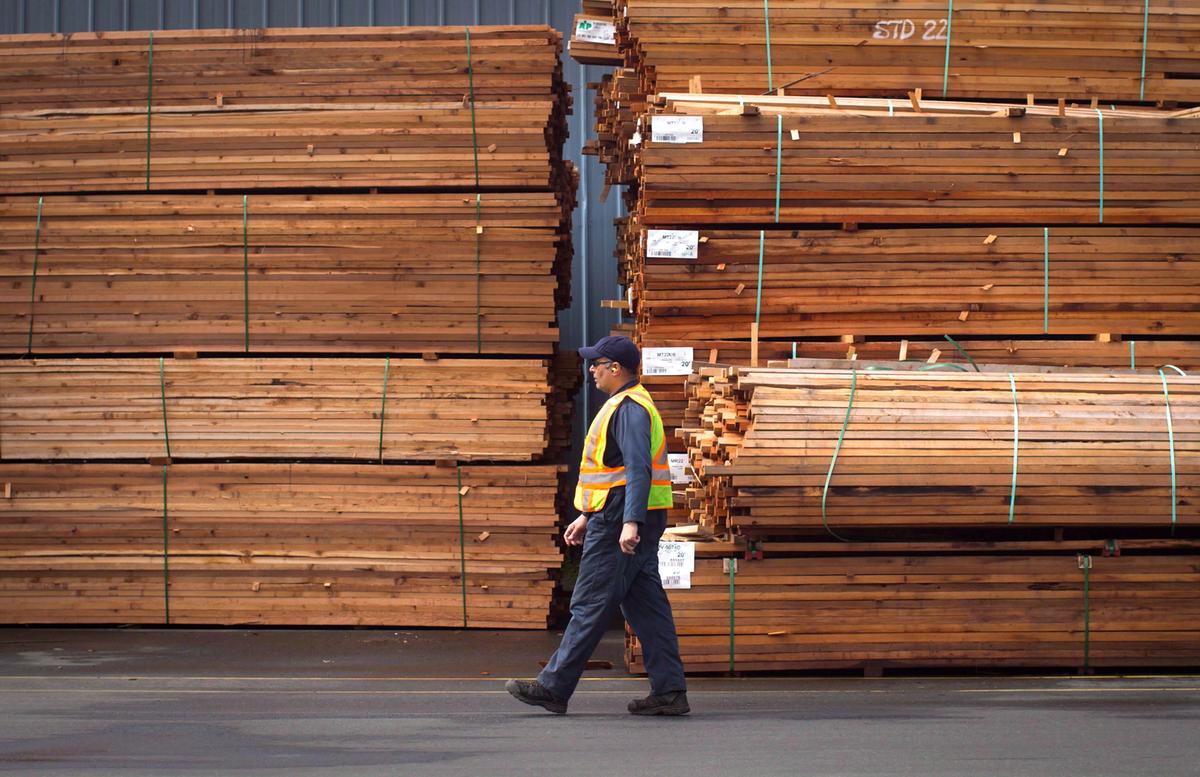
A worker walks past stacks of lumber at the Partap Forest Products mill in Maple Ridge, B.C., on Tuesday April 25, 2017. The Canadian Press/Darryl Dyck
U.S. duties and tariffs on Canadian softwood lumber could total around 35 percent under new rates announced by Washington, down from the combined 45 percent rates previously announced, following a reduction in anti-dumping duties.
In
August 2025,the U.S. Department of Commerce increased duties on softwood lumber imports from 6.74 to 14.63 percent, which when combined with the anti-dumping duty of 20.56 percent, brought the total to 35.19 percent. In October, Washington then imposed an additional 10 percent tariffs on lumber under Section 232, bringing the total combined duties to 45.16 percent.
But according to an
Oct. 14 statementfrom the B.C. Lumber Trade Council, the department’s seventh administrative review set the anti-dumping duty rate at 10.64 percent and the countervailing duty rate at 14.11 percent. Combined with the separate 10 percent Section 232 tariff, the rates bring the total to 34.75 percent, according to the council.
The exact tariff rates for Canadian lumber producers can vary, with the B.C. government noting Canfor has a total tariff rate of 31.11 percent, while Resolute has a rate of 25.55 percent, West Fraser has a rate of 20.02 percent, and all others have rates of 24.75 percent. These rates will take effect when the department releases its final review.
B.C. Lumber Trade Council Interim President Kim Haakstad said the combination of duties and tariffs continues to place a “significant burden” on Canadian lumber producers.
“For nearly a decade, this dispute has put jobs, mills and forestry communities across B.C. under pressure,” she said in the statement.
Haakstad said the United States cannot produce enough spruce-pine-fir (SPF) lumber—used in residential construction and furniture manufacturing—to meet domestic demand, meaning “part of that demand will always be met by imports, whether from Canada or outside North America.”
“Lumber crosses our shared border because builders on both sides need it. Our producers compete fairly in a market-driven system, and these duties are unjustified. It’s time to end this dispute,” Haakstad added.
The softwood lumber dispute between Canada and the United States dates back to the 1980s. About 90 percent of Canada’s forests are publicly owned, compared with roughly 90 percent of U.S. forests, which are privately owned. U.S. forestry groups have argued that Canadian lumber benefits from government subsidies and is sold at artificially low prices, putting American producers at a disadvantage.
In addition to tariffs on Canadian automobiles and auto parts, steel, aluminum and copper, Washington imposed 50 percent tariffs under Section 338 on $27.6 billion worth of Canadian goods on Aug. 22. The measures covered certain wood and value-added products, including plywood, wood mouldings, paper, packaging and particleboard, while excluding products already subject to tariffs under Section 232. Washington subsequently modified the Section 338 tariffs, effective Sept. 15.
Ottawa responded with counter-tariffs on $27.6 billion worth of U.S. imports beginning Sept. 8. These included 25 percent tariffs on certain U.S. softwood lumber products and 50 percent tariffs on specified plywood and related laminated wood products.









 English (US) ·
 Turkish (TR) ·
