

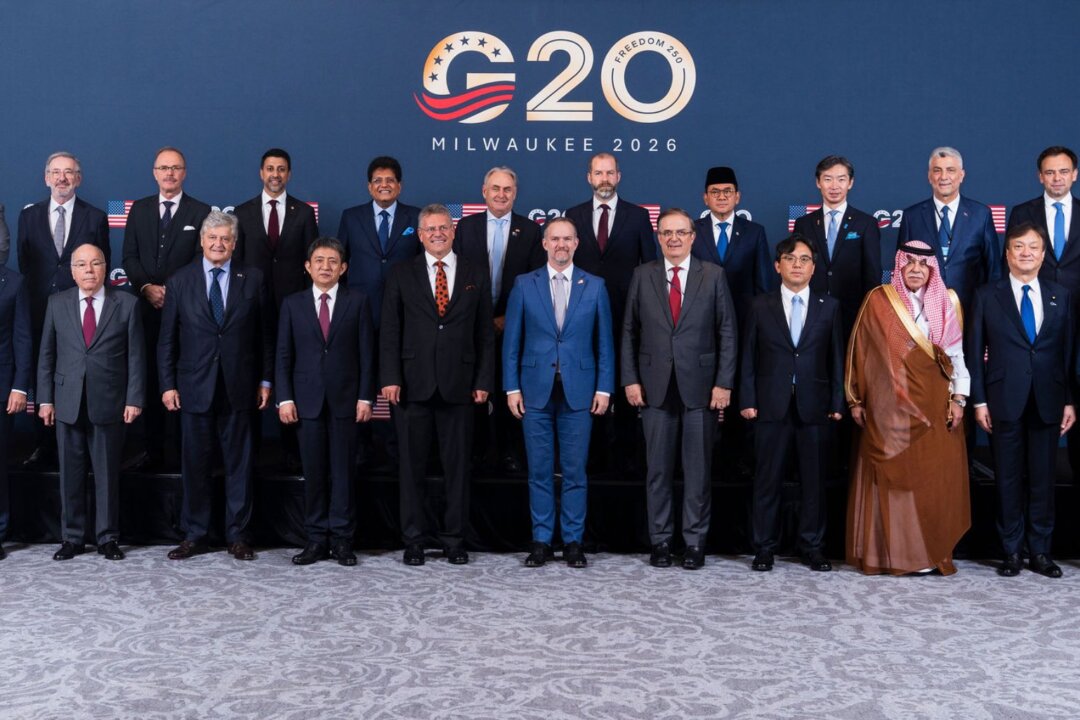
U.S. Trade Representative Jamieson Greer (C) poses with trade ministers and other delegates during the Group of 20 Trade Ministerial in Milwaukee, Wis., on Sept. 30, 2026. Courtesy of the Office of the U.S. Trade Representative
The United States is stepping up efforts against industrial overproduction from China and other economies as Washington investigates manufacturing policies it says are harming U.S. industry.
At the Group of 20 trade ministerial in Milwaukee on Sept. 30, U.S. Trade Representative (USTR) Jamieson Greer made structural excess capacity one of four priorities for the meeting, alongside forced labor, food trade, and the most-favored-nation principle.
Greer said G20 leaders had committed a decade ago to address excess industrial capacity, but “the response by the world’s economies has been mostly talk.”
“When non-market policies and practices allow production to expand far beyond domestic demand, the consequences spill across borders,” Greer said in prepared remarks. “Excess production flows into global markets, putting pressure on producers and workers elsewhere.”
Chinese Subsidies and Excess Manufacturing Capacity
USTR opened Section 301 investigations on March 11 into China and 15 other economies over what it calls structural excess capacity and production in manufacturing.
The agency said it is examining whether government policies and practices that contribute to excess production are unreasonable or discriminatory and burden U.S. commerce. Industries under review include automobiles, batteries, semiconductors, solar products, steel, aluminum, machinery, electronics, ships, and chemicals.
USTR says persistent excess production abroad can displace U.S. manufacturing and discourage new investment in American factories.
Independent research has also documented unusually heavy government support for Chinese manufacturing.
In a June 1 report, the Paris-based Organisation for Economic Co-operation and Development, or OECD, said Chinese industrial firms received on average three to eight times more government support than firms based in OECD economies between 2005 and 2024. The OECD is an international organization whose members are largely advanced economies.
The report found industrial subsidies worldwide in 2024 reached $108 billion, their highest level since 2009. It said Chinese manufacturers received relatively more support than competitors elsewhere, particularly through government grants and below-market borrowing.
Steel has become one of the clearest examples. In a June 4 report, the OECD said the median Chinese steel company received subsidies equal to 15 times the level received by producers elsewhere, measured against company assets. Chinese steelmakers exported a record 131 million metric tons in 2025, up 153 percent from 2020, as weak domestic demand pushed more production into overseas markets.
Greer also chaired a meeting of the Global Forum on Steel Excess Capacity in Milwaukee on Sept. 30. Participating economies agreed on a new “Milwaukee Framework” calling for joint action against excess steelmaking capacity and market-distorting subsidies.
In an interview with Nikkei Asia on the sidelines of the G20 trade ministers meeting, Greer said Washington expects to announce countermeasures against excess manufacturing within “weeks.”
USTR has not announced what form those measures will take or whether Greer’s timetable refers specifically to the Section 301 investigations. The investigations remain pending.
The Epoch Times asked USTR for more information on the measures. USTR did not respond by publication time.





 English (US) ·
  Turkish (TR) ·