
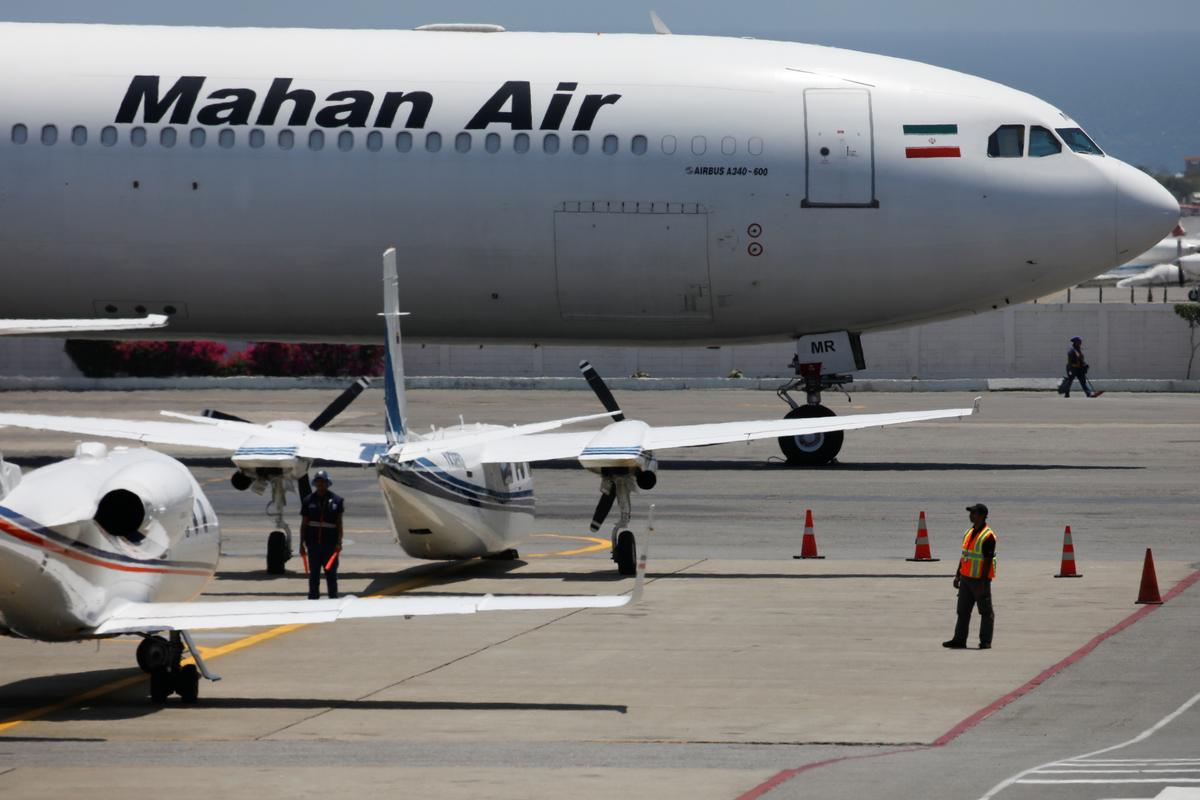
An Airbus A340-600 airplane of Mahan Air at Simon Bolivar International Airport outside Caracas, Venezuela, on April 8, 2019. Carlos Garcia Rawlins/Reuters
WASHINGTON—The U.S. Treasury Department levied a new round of sanctions against Iran’s airline sector on Sept. 8 as part of an expanding economic isolation campaign.
In all, the Treasury’s Office of Foreign Assets Control targeted 27 Iranian airline operators accused of helping transport Iranian military personnel and weapons.
The new U.S. sanctions listed another eight companies—incorporated in Turkey, the United Arab Emirates, Malaysia, Kazakhstan, and the United Kingdom—accused of circumventing existing Iran sanctions to procure aircraft and provide other support services for Iran’s aviation industry.
An Egypt-based U.A.E. national, Ibrahim Ali Mohamed Mohamed Mahran, was also named in the latest sanctions.
On Aug. 24, the Treasury Department began Operation Economic Outcast to ostracize Tehran financially.
“Let this be a warning to anyone doing business with Iran’s remaining airlines, all of which we sanctioned today: You are at risk of being cut off from the global financial system,” Treasury Secretary Scott Bessent said in a press statement.
Sanctions have targeted dozens of individuals, entities, and vessel operators accused of helping Iran collect oil revenues, procure military and nuclear technology, and mount cyber attacks.
The Treasury Department has since
proposedcutting off U.S. financial services for the United Arab Emirates branch of the Egypt-based Banque Misr, and has applied sanctions against the Turkish bank Golden Global Yatirim Bankasi Anonim Sirketi.
Washington and Tehran have continued to vie for control over the Strait of Hormuz, a maritime chokepoint along a key route for global oil exports. U.S. forces have worked to increase the number of oil tankers exiting the Strait of Hormuz, while Iranian forces have attempted to enforce restrictions over the waterway.
This past week, U.S. forces launched strikes against Iranian missile launchers and mine-laying capabilities near the strait. After Iranian forces targeted nearby U.S. warships on Sept. 5, U.S. forces launched further strikes to disable three Iranian oil tankers.
Mohsen Rezaei, the head of Iran’s Supreme National Security Council, warned this week that Iran would respond to the rising economic pressure from the United States by implementing a maritime exclusion zone over the Persian Gulf. Vessels approaching the exclusion zone without coordinating with Iran risk being sanctioned, Rezaei said.
This week, Iranian parliamentary speaker Mohammad Bagher Ghalibaf also threatened new attacks on U.S. energy assets or infrastructure across the Middle East if U.S. strikes on Iranian assets don’t cease.
Continued fighting around the Persian Gulf could raise global fuel prices. This week, Goldman Sachs global commodities research co-head Daan Struyven warned that oil could soon reach $120 per barrel, should shipping disruptions worsen.
Evgenia Filimianova contributed to this report.




 English (US) ·
  Turkish (TR) ·