
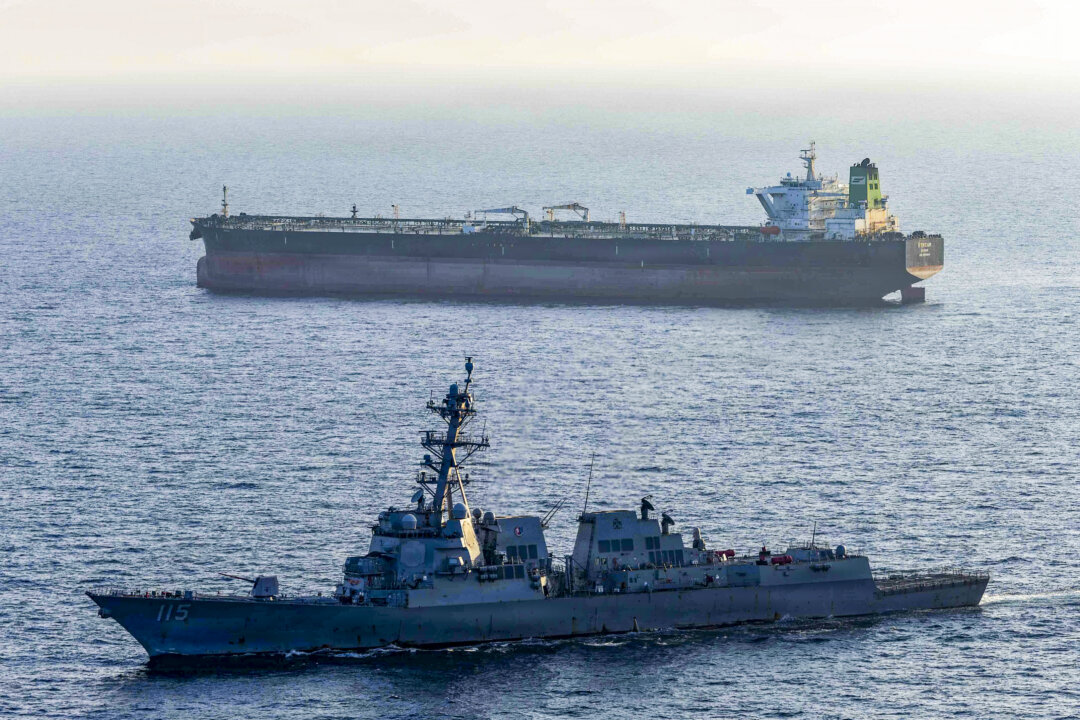
The U.S. military dismissed Tehran’s claim that its forces had struck an unmanned American vessel in the Strait of Hormuz, as Iranian officials outlined plans to tighten restrictions on maritime traffic through the strategic waterway.
Iranian state-run media said the U.S. vessel was trying to enter an area of the Strait of Hormuz that Tehran says is restricted, but Capt. Tim Hawkins, spokesperson for the U.S. Central Command, called it “a total lie.”
The Epoch Times reached out to Central Command for further comment but didn’t receive a response by publication time.
The Iranian report was published one day after U.S. forces struck three Iranian crude oil tankers following what Central Command said was an Iranian missile attack targeting two U.S. Navy warships.
These include IRGC crude oil carriers M/T Downy off Kharg Island and M/T Stark 1 near Jask. Central Command added in a Sept. 5 statement that a third vessel, M/T Kylo, also known as Noxen, was completely destroyed in the Gulf of Oman.
Iran condemned the attacks in a Sept. 5 statement, saying the United States and its partners would bear responsibility for the consequences of what it called Washington’s “aggressive and destabilizing actions” in the region.
Iran Plans Tougher Shipping Restrictions
Iranian state media also reported that Iranian lawmakers approved a measure to regulate transit through the Strait of Hormuz.
Hassan Qashqavi, spokesperson for the parliamentary commission reviewing the proposal, said on Sept. 7 that the measure would bar countries, companies, and individuals that impose unilateral sanctions on Iran or carry out what Tehran considers hostile acts from transiting the waterway, according to the report.
Qashqavi said Iran’s Armed Forces General Staff would decide which actions are considered hostile, while the Iranian Supreme National Security Council (SNSC) would determine which countries and institutions are subject to the restrictions.
Separately, SNSC Secretary Mohsen Rezaei said Tehran would soon announce a new exclusion zone outside the strait designed to regulate ships approaching the waterway.
“In the coming days, we will announce a new exclusion zone covering the area between the U.S. blockade line and the loading ports,” Rezaei told Iran’s state broadcaster IRIB on Sept. 6.
He added that vessels heading toward the Strait of Hormuz without coordinating with Iran could be placed on Iran’s sanctions list, potentially facing insurance complications and restrictions on future passage.
Rezaei also said Iran would not reopen the Strait of Hormuz until the United States first implemented practical measures, arguing that Tehran no longer trusted U.S. guarantees. He added that a new international shipping corridor agreed with Oman would be announced in the coming days.
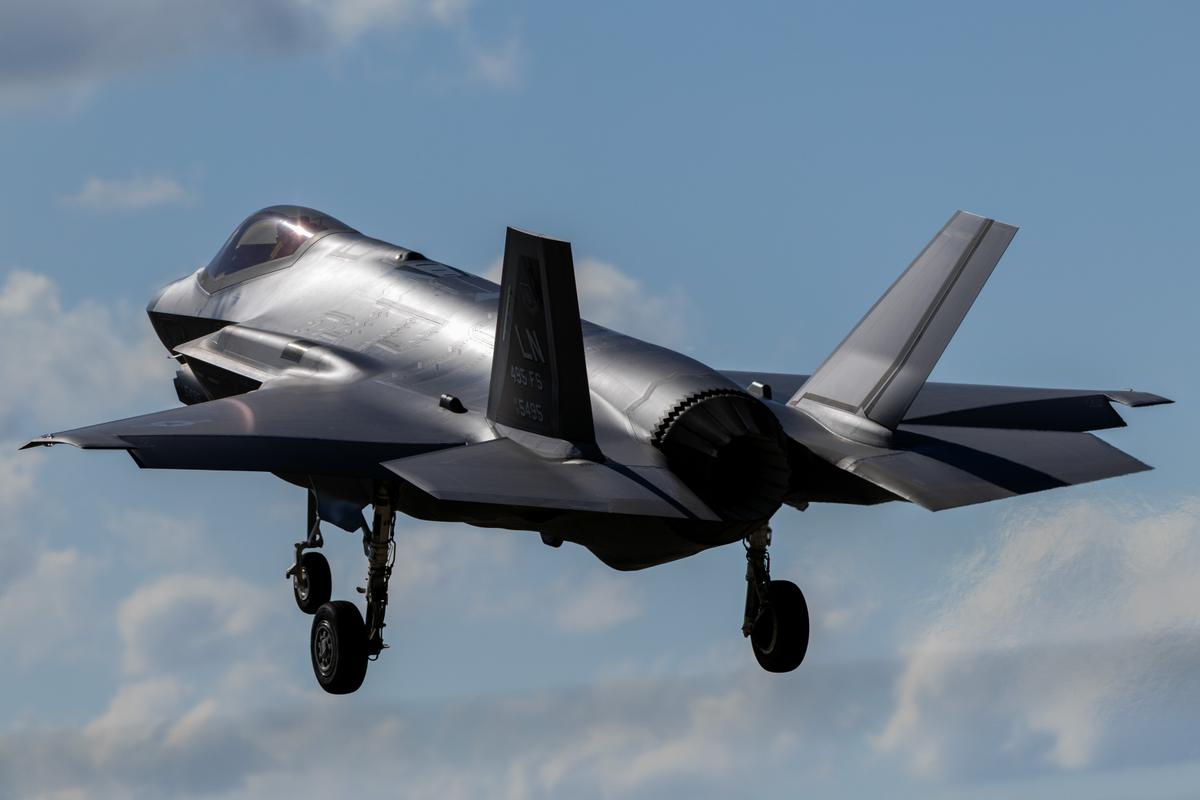
A U.S. Air Force fifth-generation F-35A Lightning II stealth aircraft comes in to land in Lakenheath, England, on April 17, 2025. Dan Kitwood/Getty Images
The United States continues to enforce maritime restrictions against Iran. Central Command said that a U.S. Air Force F-35A fighter jet was patrolling the region as U.S. forces continued enforcing a maritime blockade.
It said U.S. forces had redirected 92 commercial vessels, disabled three, and boarded two as of Sept. 6.

Ships are anchored in the Strait of Hormuz, off the coast of Bandar Abbas, Iran, on August 10, 2026. Ali Saeedi/Getty Images
Shipping through the Strait of Hormuz has slowed, with an average of 10 commodity ships transiting the waterway each day over the previous 10 days, the lowest level since May.
Iran and the United States signed a preliminary agreement in June to halt the war that began in late February and fully reopen the Strait of Hormuz. The ceasefire collapsed on July 7 after U.S. President Donald Trump declared it over and ordered strikes, accusing Iran of attacking ships in the strategic waterway.
Since then, the two countries have resumed military action while diplomatic efforts have stalled.
U.S. Energy Secretary Chris Wright said on Sept. 6 that an agreement with Iran might not be possible until the country’s current government is removed from power. The energy secretary also said oil was getting through the waterway.
“Our transits through the Strait are averaging over 9 million barrels a day now, and with the access pipelines that go around the strait, we’re probably two-thirds or more of pre-conflict flows,” he told CNN on Sunday. “So Iranians are still causing trouble, but the United States Navy is winning that battle.”
Throughout the conflict, Trump has said Iran cannot be allowed to obtain a nuclear weapon, and negotiations earlier this year centered on Tehran’s disputed nuclear program. Iran has maintained that its nuclear activities are for peaceful purposes.
The Associated Press and Reuters contributed to this report.



 English (US) ·
  Turkish (TR) ·