

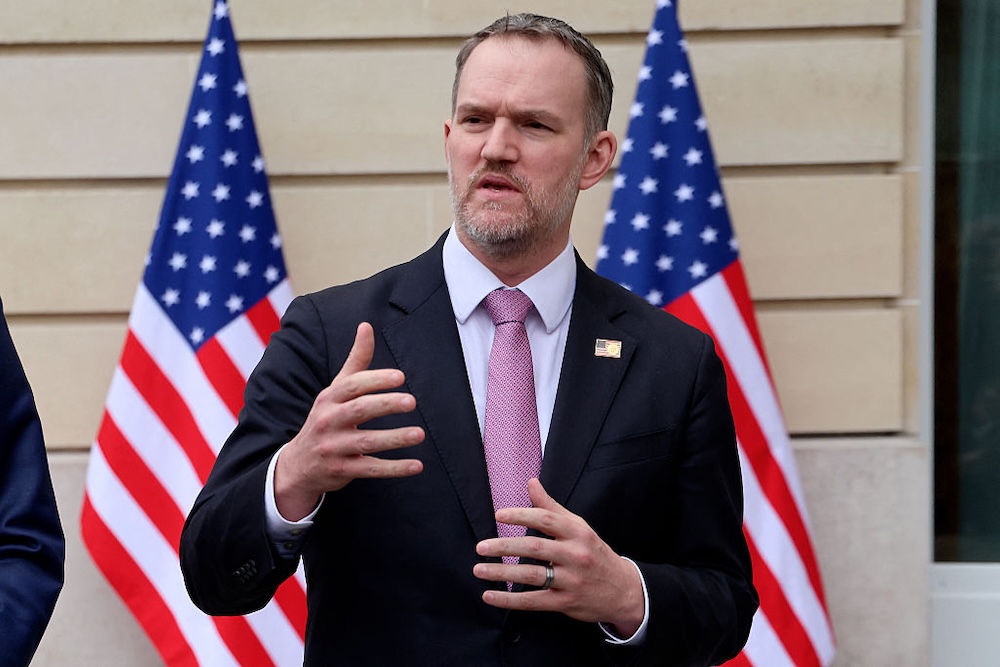
U.S. Trade Representative Jamieson Greer addresses journalists in Paris on March 16, 2026. Ludovic Marin/AFP via Getty Images
The United States has extended its trade probe into Vietnam’s protection of intellectual property rights by three months, with a decision on whether to impose trade measures now expected by the end of February.
The U.S. Trade Representative (USTR) said in a notice published in the Federal Register on Tuesday that the investigation involves complex issues that require additional time.
The Section 301 investigation, launched in May, examines certain acts, policies, and practices of the Vietnamese government related to the protection and enforcement of intellectual property rights.
It stems from the USTR’s April decision to designate Vietnam a “Priority Foreign Country,” a classification under U.S. law reserved for countries with the most serious shortcomings in protecting intellectual property rights.
In Vietnam’s case, the USTR cited concerns over online piracy, widespread counterfeiting, weak border enforcement, unlicensed software use, and cable and satellite signal theft.
The designation marked the first time in 13 years that the United States had placed a country in that category.
The Epoch Times reached out to the Vietnamese Foreign Ministry for comment but didn’t receive a response by the time of publication.
Vietnamese Foreign Ministry spokesperson Pham Thu Hang said on May 1 that Hanoi had improved its legal framework and increased public awareness of intellectual property rights.
She said Vietnam was willing to exchange information with Washington and believed both countries should continue working together to resolve issues.
Vietnam is also subject to a 12.5 percent general duty on many goods exported to the United States following a U.S. investigation into the enforcement of import bans on goods allegedly produced with forced labor.
Trade Relationship
USTR’s investigation is proceeding alongside broader negotiations over a bilateral trade agreement between Washington and Hanoi.
In October 2025, the two countries announced a framework for an Agreement on Reciprocal, Fair, and Balanced Trade. It is designed to expand market access for exporters from both countries while maintaining a 20 percent reciprocal tariff until the final agreement is completed.
During meetings on the sidelines of the 81st U.N. General Assembly in September, Vietnamese leader To Lam reaffirmed that economic, trade, and investment cooperation remained a central pillar of bilateral relations.

Vietnamese leader To Lam (C) during his visit to the Tokyo Stock Exchange on Nov. 11, 2026. Rie Kikuchi/AFP via Getty Images
According to the Vietnamese government, To Lam discussed finalizing the trade agreement between the two countries with U.S. Trade Representative Jamieson Greer.
In August, the Vietnamese leader called on Washington to conclude the Section 301 investigation promptly and avoid what he described as extreme trade remedy measures that could negatively affect overall bilateral relations.
Last year, total U.S.–Vietnam goods and services trade reached an estimated $215.4 billion, up 39.1 percent from the previous year.
The U.S. goods trade deficit with Vietnam widened by 44.6 percent to $178.3 billion.
U.S. services exports to Vietnam declined 2.3 percent to $3.5 billion from 2024, while imports increased 25.3 percent to $2.4 billion. The U.S. services trade surplus with Hanoi fell 33.5 percent from 2024 to $1.1 billion.








 English (US) ·
 Turkish (TR) ·
