
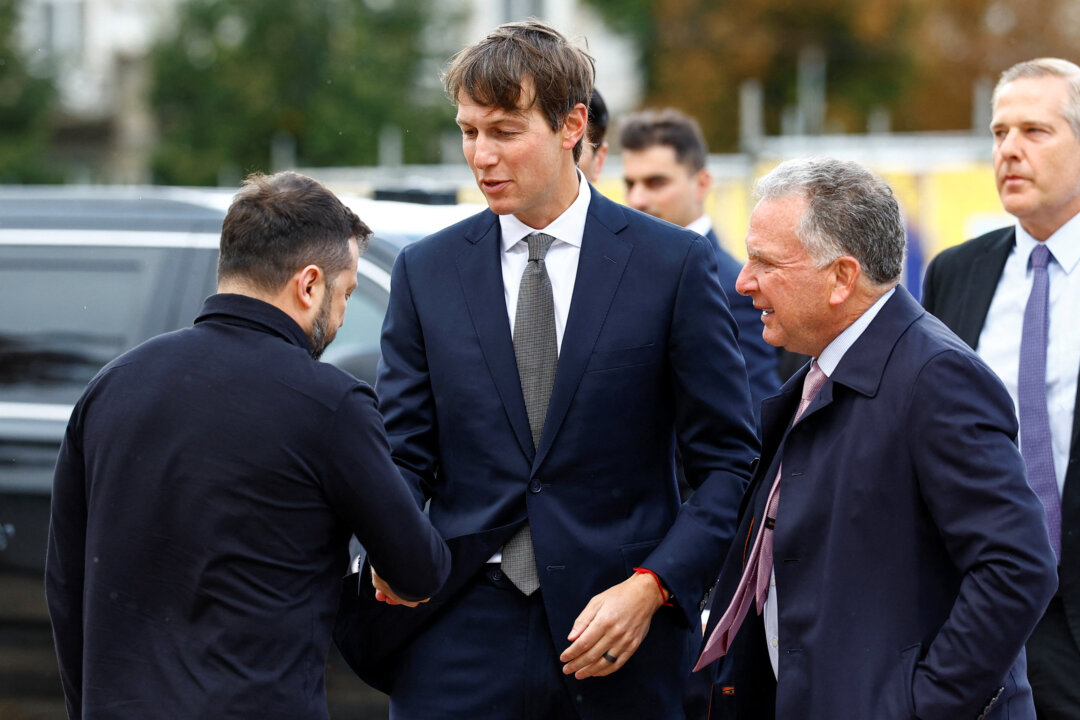
U.S. special envoy Steve Witkoff on Monday signaled new momentum had been gained in talks to bring peace between Kyiv and Moscow, following a meeting with Ukrainian President Volodymyr Zelenskyy in the Ukrainian capital on Sept. 6.
“Substantive progress was made, including movement on scheduling additional trilateral talks,” Witkoff said in a Sept. 7 post on X, summarizing the fruits of his trip to both capitals.
Witkoff and President Donald Trump’s son-in-law Jared Kushner jetted to Kyiv a day after visiting Moscow for negotiations with Russian President Vladimir Putin.
The visit marked the first time the American duo had visited Ukraine since the war began in 2022.
Although no substantive breakthrough or agreement was announced during the Sunday press conference, which involved both envoys and Zelenskyy, Witkoff said, “My job and Jared’s job … is to bring the parties together.
“To narrow the issues between them, to create good communication channels, and, hopefully, we began that process constructively in the last 48 hours, and we’re confident that there'll be a good resolution here,” he said.
At the same press conference, Kushner said that he and Witkoff thought it would be “productive” to “go back to the trilateral format, which we were able to do about six months ago,” referring to previous discussions between representatives from the United States, Russia, and Ukraine.
Kushner said that he prefers trilateral talks because they allow direct communication among all parties, rather than forcing Washington to act as an intermediary between Moscow and Kyiv.
On the previous talks, he said that “everyone was speaking, you know, in Russian to each other and really discussing these issues in a very actually friendly manner. All in Russian.”
He said that the United States expressed this view to both parties, adding that he was hopeful of having “progress on that very soon.”
Previous trilateral talks—most recently in Geneva, Switzerland, in February—have failed to resolve key issues such as territory and security guarantees for Ukraine.
Zelenskyy thanked both Witkoff and Kushner for being in Kyiv, and said that during the day, they had held three rounds of negotiations, adding that “all of them were very substantive.”
He joked that the U.S. envoys’ presence had “worked even better” than the Patriot missile defense systems Ukraine has relied on to defend itself from Russian attacks, in an allusion to the three-day cessation of hostilities that had been agreed between Kyiv and Moscow to ensure Kushner and Witkoff’s safe passage.
“Please come visit more often, and our people will have a chance—a chance to live a little,” he said.
Zelenskyy said that he was “grateful” that negotiations had resumed after such a long pause, adding that while Ukraine had preferences for one format of negotiations, it was worse when there was none at all.
He said he still viewed the “territorial issue” as “relevant,” but added that his raising it in the conference did not mean much time was spent discussing it during negotiations.
Zelenskyy further stated that in his opinion, issues as complex as post-war territory can only be “resolved at the level of leaders.”
The Ukrainian president has previously written an open letter to his counterpart suggesting a meeting between them, a notion that was rebuffed by Putin.
“But the main thing is that today we have the opportunity to discuss everything—security guarantees, and we are indeed talking about Ukraine’s future,” Zelenskyy said.
He added that along with security guarantees, economic guarantees had also been discussed during the negotiations.
“And we all want—we stand in solidarity here—to end the war as soon as possible,” he said.
He further said that, though he viewed the talks as a positive development, the war was still likely to continue into the winter.
Moscow’s View
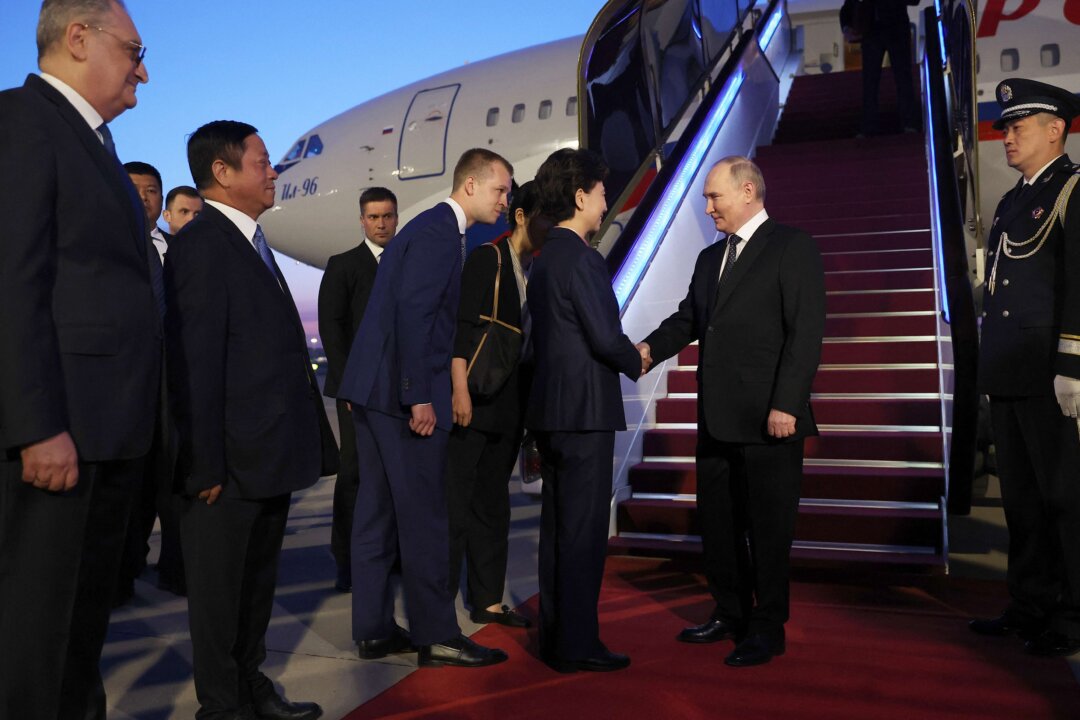
Kremlin aide Yuri Ushakov told reporters that Witkoff and Kushner “outlined a number of ideas regarding possible avenues for a settlement,” after the pair’s three-hour talks with Russian officials, including Putin, concluded on Sept. 5.
“The talks went beyond a mere exchange of views on resolving the Ukrainian crisis. Economic issues and potential major, mutually beneficial Russian-American projects were discussed in some detail,” he said.
He did not elaborate.
“Overall, one can say that the negotiations were timely and highly useful for both sides.”




 English (US) ·
  Turkish (TR) ·