
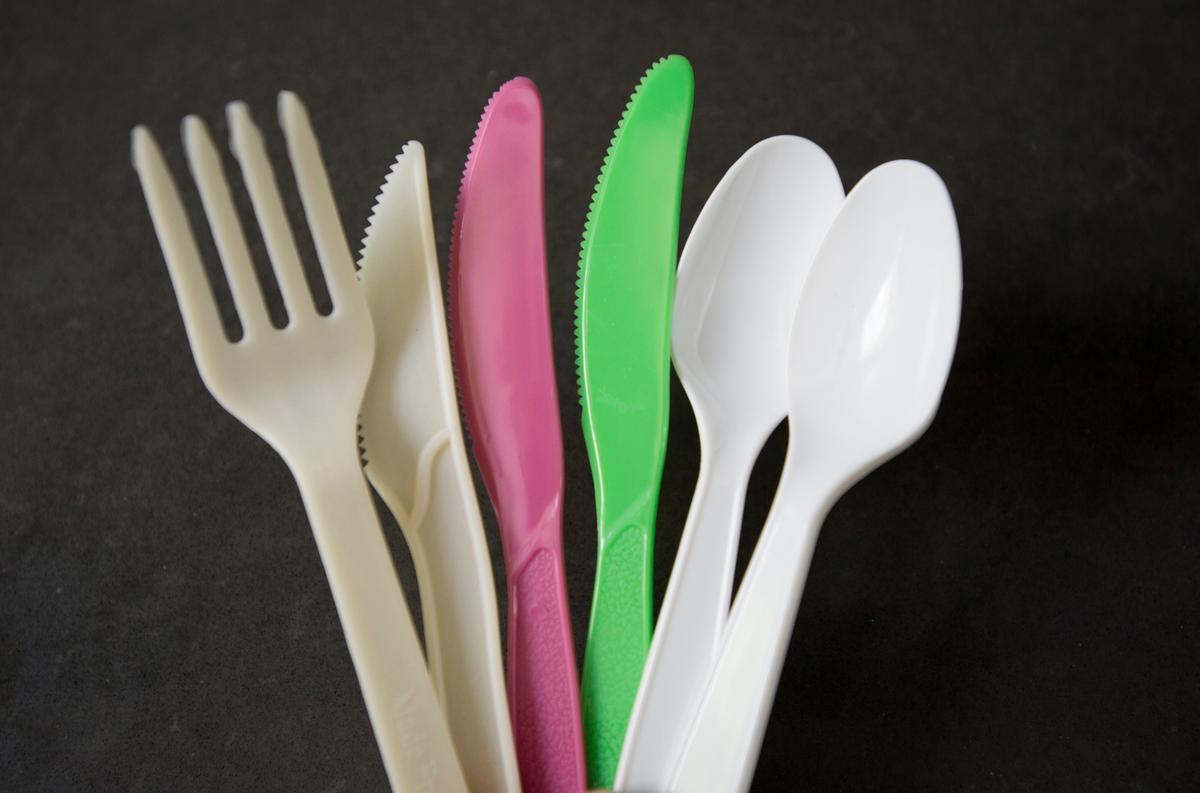
Plastic cutlery is pictured in North Vancouver, B.C, on June, 10, 2019. Jonathan Hayward/The Canadian Press
Canada’s top court has announced it will hear an appeal of the federal government’s ban on single-use plastics.
The Supreme Court of Canada made the announcement in an Oct. 15 press release, saying it would grant the appeal “with costs in the cause.”
The case will determine whether Ottawa had the legal authority to classify plastic manufactured items as toxic under the Canadian Environmental Protection Act, a designation used to underpin the ban.
The announcement comes more than five years after the federal government added “plastic manufactured items” to the list of toxic substances under the Canadian Environmental Protection Act.
Cabinet formalized the decision in April 2021, and the Liberal government began phasing in restrictions on the manufacture, import and sale of six categories of single-use plastics in December 2022. The restrictions took effect in stages through 2024.
The regulations cover checkout bags, cutlery, takeout containers, ring carriers used to hold beverage cans together, stir sticks, and straws—all items the government said were commonly found in litter and had readily available alternatives.
An industry group called the Responsible Plastic Use Coalition challenged Ottawa’s restrictions and Federal Court Justice Angela Furlanetto struck down the ban in 2023.
The coalition is a Canadian not-for-profit advocacy and industry group made up of plastics manufacturers, recyclers, distributors, and major chemical companies like NOVA Chemicals, Dow Chemical Canada ULC, and Imperial Oil Limited.
They argued that Ottawa’s decision lacked a solid foundation because insufficient testing had been conducted to identify which plastics pose genuine environmental risks.
Furlanetto agreed in her November 2023 ruling, saying the federal government’s blanket classification of all plastic-manufactured items as “toxic” was unreasonable and unconstitutional.
She said the ban was too broad because the federal government had failed to demonstrate that all plastic items cause harm to human health or the environment. She also found it encroached upon provincial and territorial jurisdiction.
A three-judge panel at the Federal Court of Appeal overturned that lower court decision in a unanimous ruling in January, allowing the ban to remain in place.
The trio of appellate judges determined that the lower court’s decision was made on a flawed assumption, and ruled that the ban did not encroach upon provincial or territorial powers.
The ruling noted that “the chemical content of [plastics] is irrelevant to the sea otter choking on a plastic straw,” adding that the problem “is the plastic item itself, not its chemistry.”
The plastics ban had been in the works for years before it was implemented.
In 2018, Canada spearheaded the Ocean Plastics Charter at the G7 summit. The initiative was followed by then-prime minister Justin Trudeau’s June 2019 announcement that Canada would ban harmful single-use plastics as early as 2021.
“We have a responsibility to work with our partners to reduce plastic pollution, protect the environment, and create jobs and grow our economy,” Trudeau said at the time. “We owe it to our kids to keep the environment clean and safe for generations to come.”
Ottawa has since proposed changes to the regulations governing exports of the prohibited products.
In December 2025, the federal government proposed allowing the manufacture, import and sale of the six categories of single-use plastics for the purpose of export, while keeping the domestic restrictions in place. The export prohibition had come into force on Dec. 20, 2025.
The government said the export prohibition’s environmental benefits did not justify its economic costs.
“The prohibition on export will not fulfil an environmental objective commensurate to its economic impact,” the government said in a Dec. 20 statement, adding that “the prohibition on export is not required to ensure that the regulations effectively protect the environment from the harms of plastic pollution.”
The federal Conservatives have been critical of Ottawa’s domestic ban.
Conservative MP Dan Albas also criticized the government’s proposed export changes last December, arguing that allowing Canadian companies to manufacture prohibited plastics for foreign markets while maintaining the domestic restrictions would contradict Prime Minister Mark Carney’s statement that Canada would be its “own best customer” amid U.S. tariffs.








 English (US) ·
  Turkish (TR) ·