
The chief executive of the world’s largest oil company warned that it could take up to two years to rebuild crude and fuel stockpiles depleted during the conflict in the Middle East.
Saudi Aramco’s Amin Nasser told an energy conference in London on Oct. 5 that until the Strait of Hormuz, a key route for global oil shipments, fully reopens and confidence returns, “the crude reality is that pressure at both ends of the barrel will intensify.”
“Even then, replenishing inventories while meeting demand could take up to two years,” he added.
The disruption to shipping through the Strait of Hormuz following the start of the Iran conflict—together with Houthi attacks affecting the Red Sea and the Bab al-Mandeb Strait—has disrupted global shipping, tightened energy supplies, increased prices, and added uncertainty to energy markets.
Nasser said the disruption has affected ocean freight, tightened supply chains, and increased concerns over inflation and the availability of essential goods.
He also said shortages of aluminum, sulfur, helium, and petrochemicals have affected renewable energy technologies, including solar panels, wind power equipment, and electric vehicles.
The International Monetary Fund warned in April that global economic growth could slow to about 2 percent in 2026 under a severe scenario in which damage to energy infrastructure in the conflict region becomes more extensive.
Under that scenario, global headline inflation would rise to just above 6 percent by 2027.
“The longer the disruption continues, the risk of this happening only grows,” Nasser said.
He told the conference that the world entered the crisis with almost 10 billion barrels of oil in global inventories.
Since then, he said, nearly 3 billion barrels of gross oil supply have been lost, equivalent to roughly half of the crude oil and petroleum products that would normally have moved through the Strait of Hormuz over the same period.
More than 1 billion barrels were supplied from existing inventories to help offset the disruption, Nasser said, warning that most remaining commercial stockpiles are not readily available.
“The system is already straining,” he said. “With precious little else the world can turn to, the supply resilience cushion is scarily thin.”
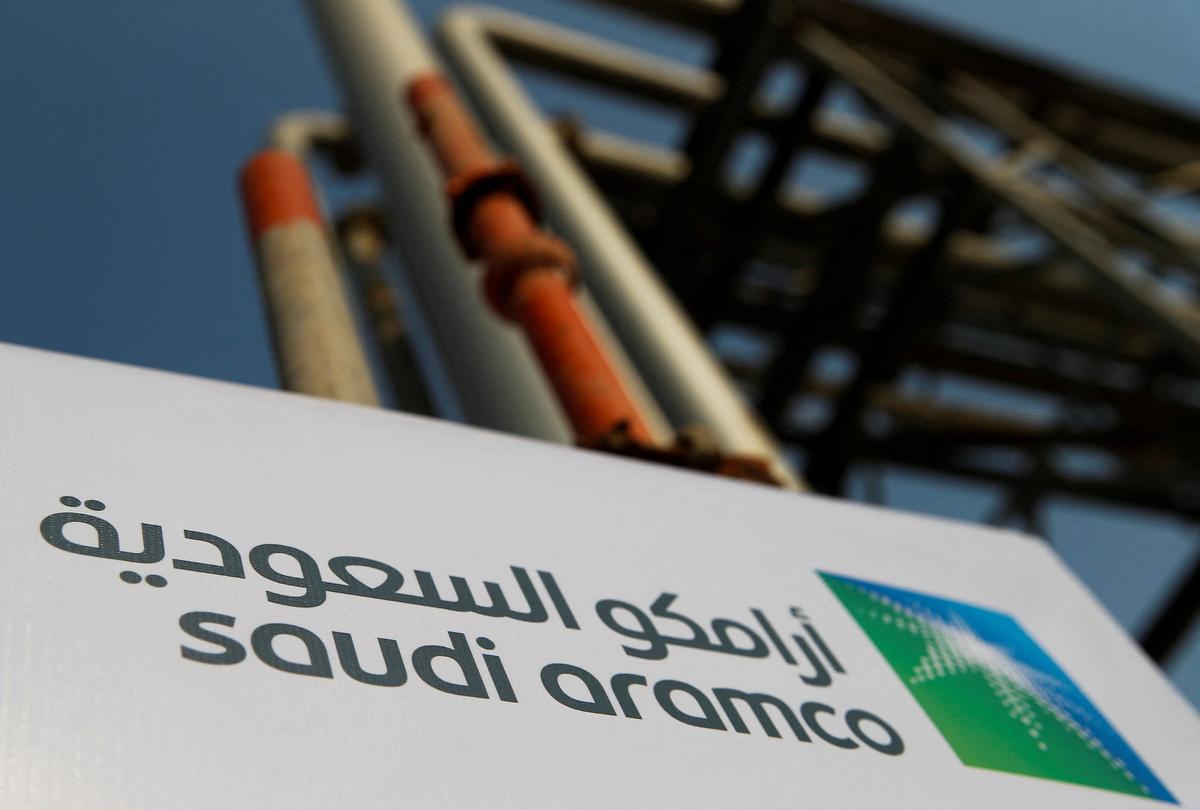
A Saudi Aramco logo at its oil facility in Abqaiq, Saudi Arabia, on Oct. 12, 2019. Maxim Shemetov/Reuters
The Aramco executive’s comments came after the G7 said last week they would release up to 100 million barrels of diesel and crude oil from their strategic reserves over the next four months in response to supply disruptions linked to the Iran conflict.
Earlier this spring, the International Energy Agency agreed to release about 400 million barrels of oil, while core members of OPEC+ said on Oct. 4 they would maintain their required oil production levels through November.
“Existing buffers have cushioned the blow and bought time, but they are finite,” Nasser said.
“While the squeeze on crude is serious, refined fuel prices have risen even more sharply.
“Emergency reserves might buy us a winter. They cannot fix long-term supply.”
Brent crude futures traded at about $102.30 a barrel on Oct. 5, while U.S. West Texas Intermediate crude traded at $90.62 a barrel.
Middle East Central to Global Supply
Nasser said the Middle East will remain essential to global energy markets because of the region’s oil reserves and production capacity.
“There is also the physical reality that half the world’s proven oil reserves are in the Middle East, along with most of its spare production capacity,” he said.
“Markets can diversify suppliers. They cannot diversify geology.”
He said countries can reduce their dependence on individual shipping routes, but the strategic importance of the Middle East is expected to grow as oil resources elsewhere mature and become harder or less economical to develop.
Nasser said Saudi Aramco is studying additional routes for crude oil exports and expanding overseas storage to help reduce the impact of future supply disruptions.
“Multiple export routes, which can be adapted in real time, already reduce the risk that a single chokepoint can paralyze the system,” he said.

Commercial vessels are anchored off Yemen’s coast at Bab al-Mandeb, in the straits connecting the Red Sea with the Gulf of Aden and the Indian Ocean on Sept. 12, 2026. AFP via Getty Images
Aramco’s East-West Pipeline was shut after a Sept. 11 drone attack attributed to the Iran-backed Houthis.
The pipeline transports crude oil from the Abqaiq oil field in eastern Saudi Arabia to the Red Sea port of Yanbu, allowing exports to bypass the Strait of Hormuz.
“We are studying additional routes for crude exports, while exploring more overseas storage to help cover short-term disruptions,” Nasser said.
Nasser said the turmoil extends beyond the Strait of Hormuz, citing attacks on Saudi Aramco facilities as well as developments in the Gulf of Oman, the Red Sea, and the Bab al-Mandeb Strait.
“While the kingdom is capable and confident, and its systems are coping, no country should face this alone,” he said.
Last month, the G7 nations called on Iran to end its arming of and support for Yemen’s Houthis, warning that Tehran’s backing threatened international trade and global energy security.




 English (US) ·
  Turkish (TR) ·