
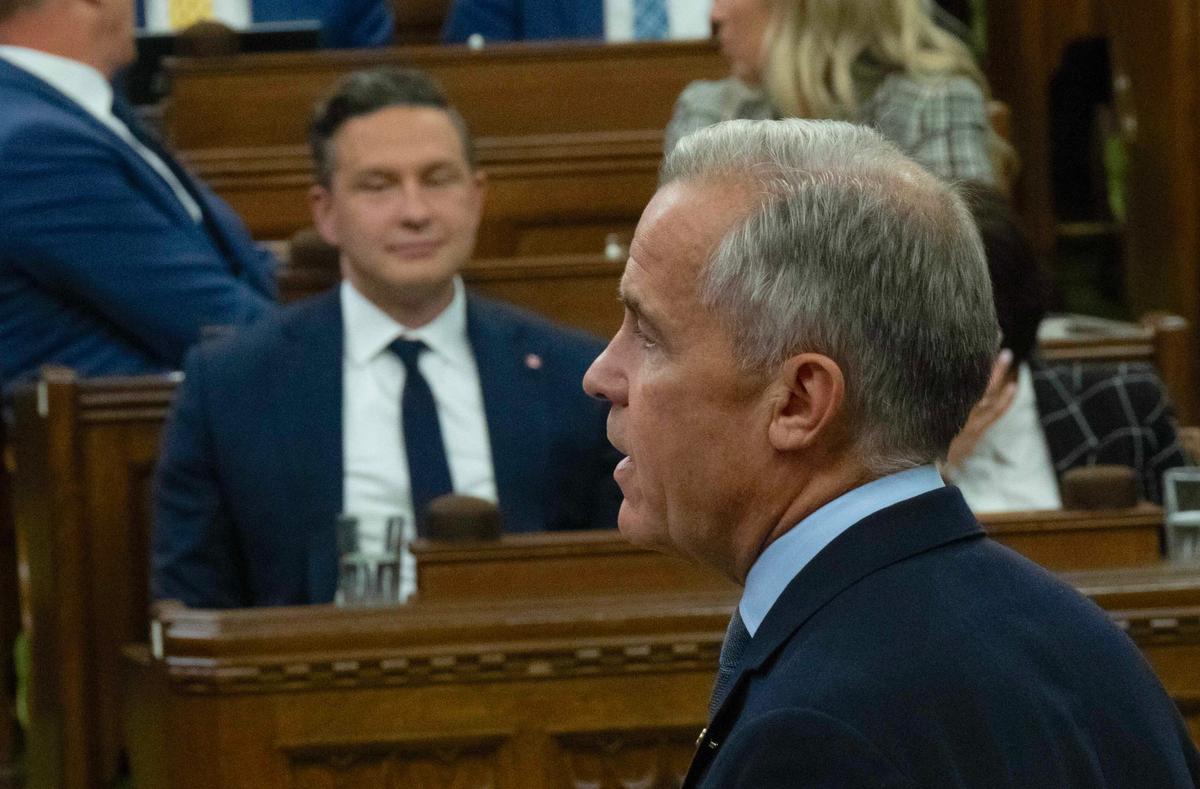
Prime Minister Mark Carney rises during question period on Parliament Hill in Ottawa on Sept. 15, 2025. The Canadian Press/Adrian Wyld
Conservatives questioned the Liberal government about the use of foreign-sourced materials in major projects fast-tracked on the condition that local materials be prioritized, and amid a push to favour Canadian companies in government contracts.
During question period as the House of Commons returned on Oct. 5, Tory Leader Pierre Poilievre asked why the government’s purchases from American companies have increased, while the fast-tracked LNG Canada Phase 2 facility will be using Chinese steel in prefabricated sections.
“The prime minister made a big show of promising to buy and build Canadians, but it was all talk and no results,” Poilievre said.
Poilievre referenced a Toronto Star report that found that since Ottawa implemented its Buy Canadian Policy in
December 2025—which prioritizes using domestic suppliers in federal procurement—purchases from American businesses had risen to a total of $7.8 billion, marking an increase of 50 percent.
Prime Minister Mark Carney responded that his government had set up the policy to complement “huge projects and investments,” such as $2 billion for a General Dynamics facility in Ontario to build armoured combat support vehicles, $100 million for new advanced submarines, and the “largest pipeline in Canada.”
“While the leader of opposition is sleeping, this government is acting,” Carney shot back at Poilievre.
Carney and Alberta Premier Danielle Smith announced on Oct. 1 that Ottawa would classify a pipeline from Alberta to British Columbia as a project of national interest, which would accelerate federal approvals and regulatory reviews. Carney said that designating the pipeline, which will be known as “Pacific Link,” under Schedule 1 of the Building Canada Act will allow the conditions for the pipeline to be finalized by Sept. 1, 2027.
Poilievre also asked about news that the Phase 2 LNG expansion project in Kitimat, B.C., will use Chinese steel in large pre-fabricated structures—news that came the same week steel manufacturer Stelco Holdings Inc. announced that it would indefinitely idle finishing operations at its steel plant in Hamilton, Ont. Stelco said on Sept. 28 the decision was due to “market uncertainty” stemming from U.S. tariffs and could impact as many as 500 employees.
“Why is the prime minister sending our steel jobs to Beijing?” Poilievre asked, to which Carney responded that he was glad the Tory leader had brought up the “second largest private sector investment in history.”
Carney said the Pacific Link pipeline will be built using 15,000 tonnes of Canadian steel, and that the workers of Stelco deserved “better from their American-owned parent,” Cleveland-Cliffs. Carney added that Ottawa would “pursue [Cleveland-Cliffs] to the full force of the law to honor their commitments.”
Cleveland-Cliffs CEO Lourenco Goncalves said in a Sept. 30
interviewthat the company’s purchase of Stelco in 2024 was predicated on being able to freely sell steel produced in Hamilton to buyers in the United States, but that U.S. tariffs on Canadian steel had changed the company’s calculations. He added that the company is acting within its rights.





 English (US) ·
  Turkish (TR) ·