
The Chinese regime’s new military partnership extends its power projection across Southeast Asia and supports air operations abroad, experts say.
The China–Laos Joint Support and Training Center and the China–Laos Friendship Aviation Academy at Laos’ Ban Keun Airport officially began operating on Sept. 29, according to China’s Defense Ministry.
The center is aimed at “helping Laos strengthen the training of its air force pilots,” the ministry said in a Sept. 30 report.
The move complies with “relevant international law” and is “not directed against any third party,” it claimed.
Mark Cao, a U.S.-based military tech analyst, said the facility expands “Beijing’s power projection options and resilience across mainland Southeast Asia.”
“This is a long-term investment in arms sales and military influence,” Cao told The Epoch Times. He also hosts the Chinese-language military news YouTube channel “Mark Space.”
“From Djibouti to Ream to Ban Keun, a mature template has clearly emerged, one that is likely to be extended to other countries dependent on China,” he said.
China’s People’s Liberation Army (PLA)
openedits first overseas base in the Horn-of-Africa nation of Djibouti in August 2017 and a joint logistics and training center at Cambodia’s Ream Naval Base in April 2025, making Laos its third host country.
The regime pledged that the Ream facility, like the one in Laos, would comply with international law and target no third party. Still, the base has long raised concerns in Washington and other capitals that it could become a PLA Navy outpost, a prospect Phnom Penh has ruled out.
Cao said Beijing reuses the wording to avoid the “military base” label, lowering the guard of member states of the Association of Southeast Asian Nations (ASEAN).
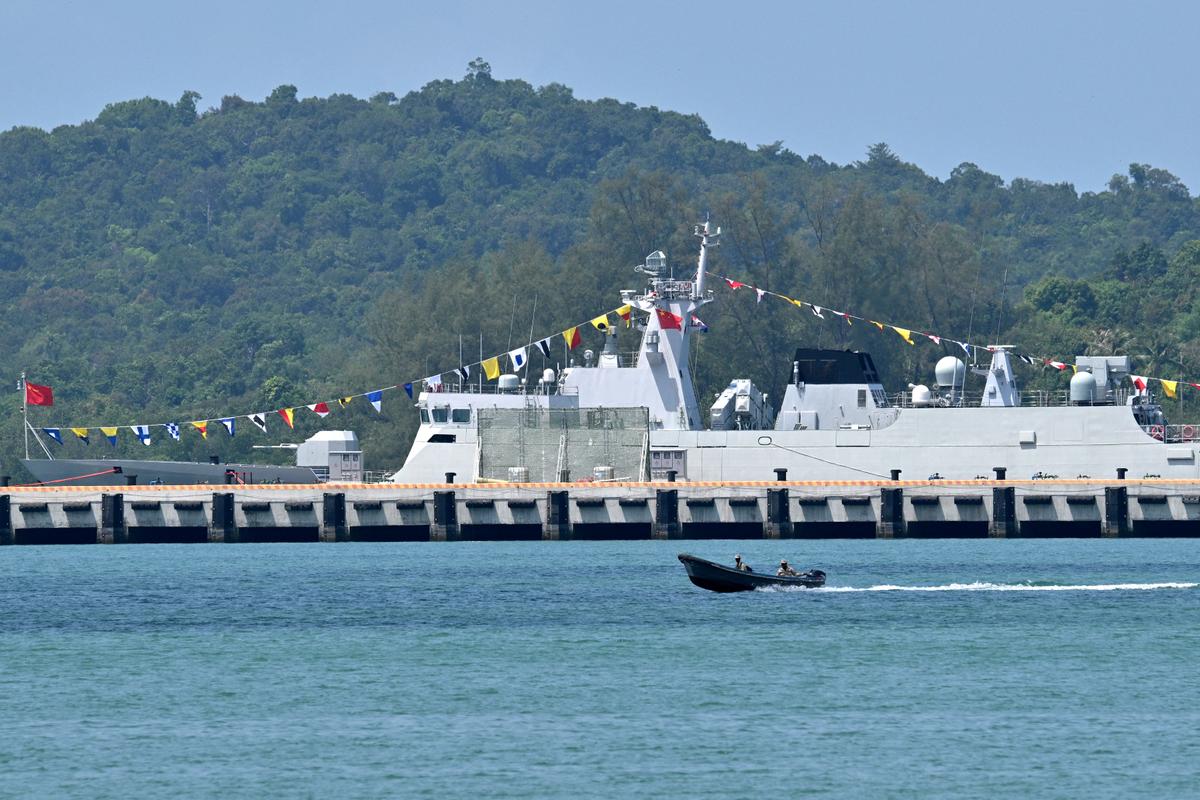
Cambodian soldiers travel on a speedboat near a Chinese warship docked at the Ream Naval Base in Preah Sihanouk province on April 5, 2025. Tang Chhin Sothy/AFP via Getty Images
Cao said one possible reason the Chinese regime chose Laos is that the landlocked nation—which borders China, Vietnam, Thailand, Cambodia and Burma—is the geographic hub of the Indochinese Peninsula.
“From Ban Keun Airport, the operational radius of air activity can cover northeastern Thailand, Vietnam’s western flank, eastern Burma, and northern Cambodia,” he said.
“In other words, it is an air node reaching deep into the heart of the peninsula.”
Laos, like China, is under one-party communist rule and ranks among the poorest in Southeast Asia. It maintains close political ties with the regime and has grown
relianton investment from China’s Belt and Road Initiative.
Huang Chung-ting, an associate research fellow at Taiwan’s Institute for National Defense and Security Research, said the center builds on years of steady military cooperation between the two countries in joint drills, education, border defense and logistics, turning periodic exchanges into a longer-term aviation partnership.
“For China, this helps deepen ties with Lao forces in flight training, equipment handling and supply systems,” Huang told The Epoch Times.
“This also gives the PLA hands-on experience supporting air operations abroad.”
Deepening ASEAN Divisions
Cao said the Laos facility is too far from the Taiwan Strait and the main South China Sea theater to play much of a wartime role, but it does change Southeast Asia’s “political map and peacetime posture.”
Taiwan is a self-governed democracy that Beijing has never controlled but has vowed to
annex, possibly by force.
In the South China Sea, tensions between Beijing and Manila have escalated over the past few months, most recently when the China Coast Guard and the PLA Navy
obstructeda Philippine resupply convoy on Sept. 24.

A Chinese Coast Guard vessel, right, fires its water cannon at the Philippine BRP Datu Pagbuaya near Philippine-occupied Thitu Island, locally called Pag-asa Island, in the South China Sea on Oct. 12, 2025. Philippine Coast Guard via AP
“ASEAN operates by consensus, so a single member’s objection is enough to block a common position,” Cao said.
“Now that two ASEAN members [Cambodia and Laos] host PLA facilities, Beijing effectively holds two reliable votes in negotiations on a South China Sea Code of Conduct, which will deepen divisions within the bloc.”
ASEAN and China pledged in 2002 to work toward the South China Sea Code of Conduct, a set of rules for managing disputes in the waters. However, the pact has not been finalized, as the regime has resisted making it binding or defining its scope.
‘Salami-Slicing’ Approach
Huang said the Chinese Communist Party (CCP) is diversifying its military access across Southeast Asia.
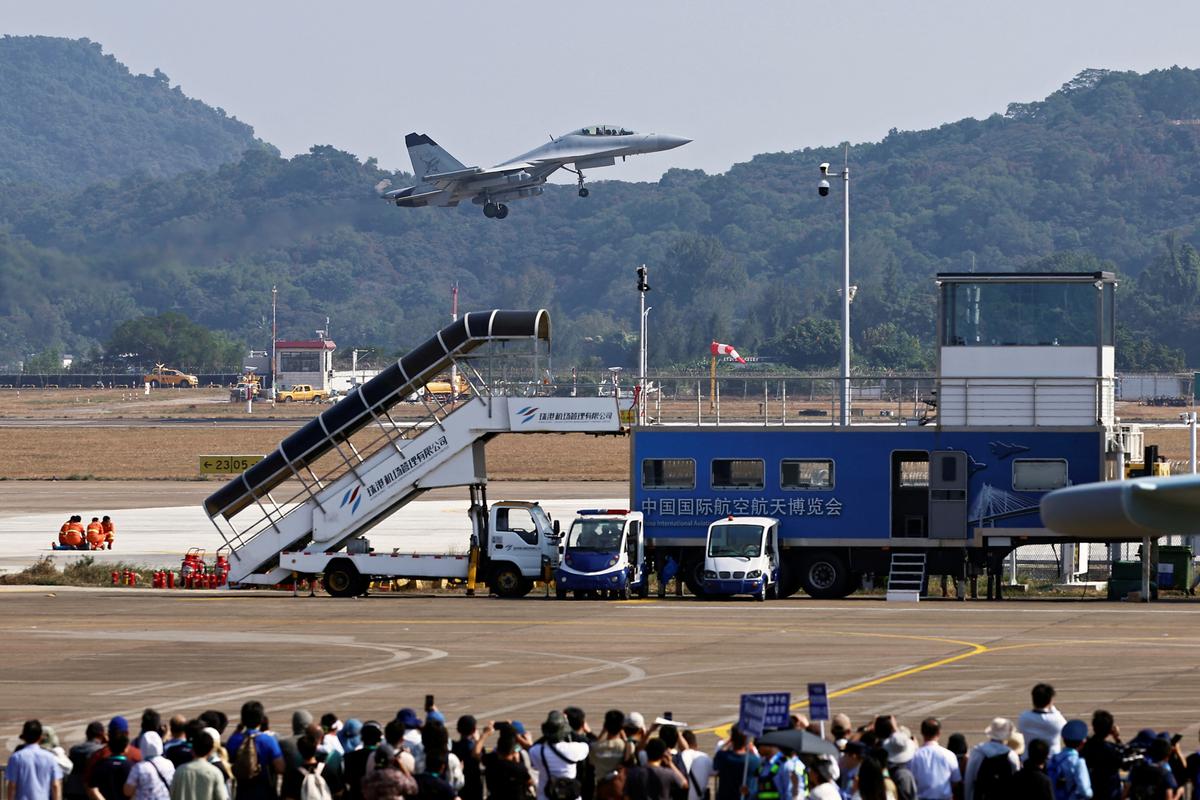
A J-15D fighter jet of the Chinese People's Liberation Army (PLA) Navy takes off at the China International Aviation and Aerospace Exhibition, or Airshow China, in Zhuhai, Guangdong province, China, Nov. 12, 2024. REUTERS/Tingshu Wang
“China’s base in Cambodia mainly provides maritime support, while Laos offers a fixed node for aviation training and logistics cooperation,” Huang said.
“These sites don’t yet add up to a complete network, but they do give PLA personnel more room to move, resupply and operate jointly in the region.”
Cao said calling the facility a “joint support and training center” also preserves Beijing’s own diplomatic narrative.
“China has long claimed that it does not station troops abroad, does not build military bases overseas, and will never seek hegemony, using this to draw a contrast with America’s global network of bases,” he said.
Cao said that an innocuous name also allows the regime to scale up gradually, so that by the time PLA forces are regularly deployed in Southeast Asia, it is too late for other countries to push back.
“A ‘training center’ or an ‘aviation academy’ sounds harmless, making it difficult for rivals to react strongly at the inauguration stage,” he said.
“This is a classic ‘salami-slicing’ approach: no single step is enough to trigger a strong reaction, but taken together, they reshape the regional landscape.”





 English (US) ·
  Turkish (TR) ·