
 1 hour ago
21
1 hour ago
21
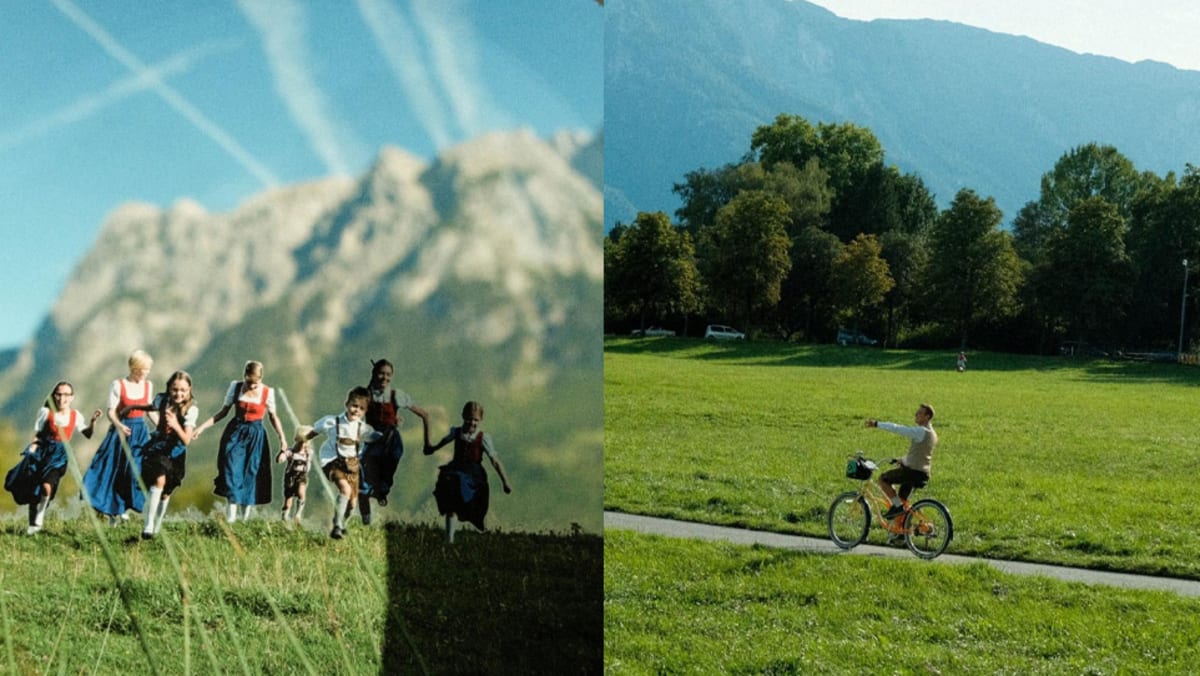
Evening light turns the lake at Leopoldskron Palace gold, and guests mill about the lawn in the crisp autumn air. In the film, this is where Maria and the children topple out of their rowing boat as the Captain comes home. Then Do-Re-Mi strikes up. In a burst of colour, dozens of children in dirndls and lederhosen come pouring out around us, spinning and bopping in joyous formation.
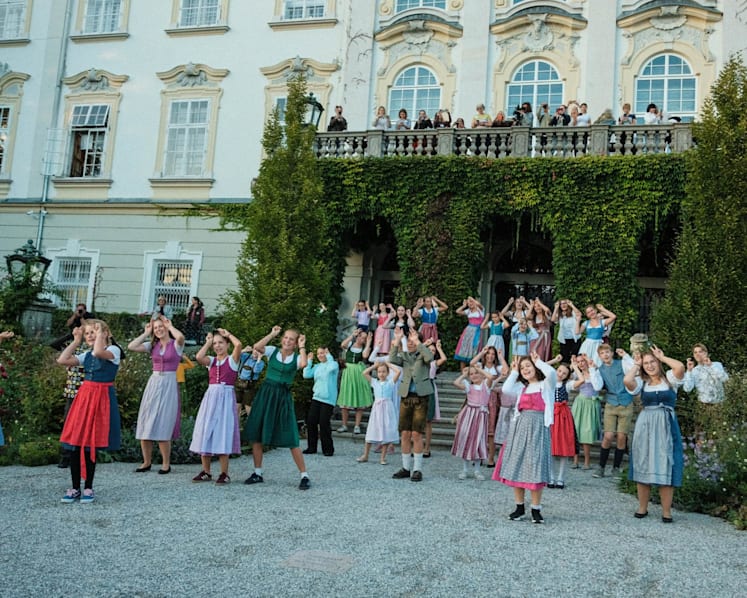 Children performing for the Sound Of Music festivities at Leopoldskron Palace. (Photo: Toh Ee Ming)
Four of the film's Trapp children are here – Nicholas Hammond (Friedrich), Duane Chase (Kurt), Kym Karath (Gretl) and Debbie Turner (Marta) – mingling with the real von Trapp descendants. Watching the two "families" take in the dance together feels like a long-overdue reunion.
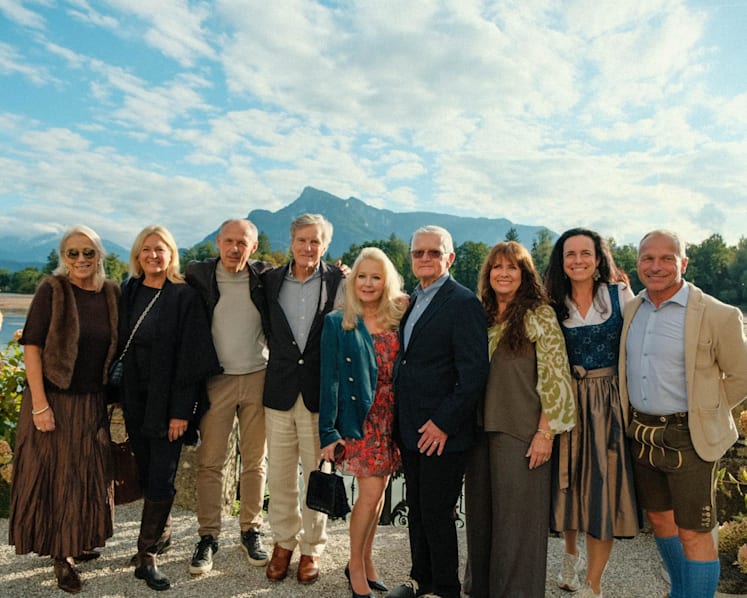 A special reunion at Leopoldskron Palace for Nicholas Hammond (Friedrich), Kym Karath (Gretl), Duane Chase (Kurt) and Debbie Turner (Marta), four of the seven von Trapp children in the 1965 film. (Photo: Toh Ee Ming)
WHERE HOLLYWOOD MEETS HISTORY
Few films have shaped the world's image of Salzburg as powerfully as The Sound Of Music. After its premiere in March 1965, the musical film starring Julie Andrews and Christopher Plummer swept five Oscars and became a global hit. More than 350,000 visitors still travel to Salzburg every year to explore its filming locations. Salzburgers were far less charmed. For years many had never even seen the film, and those who had seen it often wrote it off as Hollywood kitsch.
Nor did the city have one place to tell the full story, from the real von Trapp family, who became a successful touring choir and left Austria after the Nazi annexation in 1938, through to the Broadway and Hollywood productions and the film's global reach. Sound Of Music Salzburg, a new museum years in the making, opened in late September to fill that gap.
The museum sits in a restored hunting lodge and coach house on the grounds of 17th-century Hellbrunn Palace, a few minutes' walk from the original gazebo where Liesl and Rolf dance through a thunderstorm. The first room drops you straight into the film’s iconic opening, with Andrews spinning across a mountaintop shown on a giant screen. Next, we take in behind-the-scenes footage from the set, shot by a teenage Hammond on a cine camera he got for his 14th birthday during filming.
In the coach house, the story unfolds from Maria's 1949 memoir to a German film, Rodgers and Hammerstein's 1959 Broadway hit and, finally, Robert Wise's cinema classic. A highlight is a replica of the gazebo that doubles as a 360-degree projection room. When Sixteen Going On Seventeen plays, the surround sound swells and gusts of wind and rain lash at the panes, and visitors are free to prance and leap along as Liesl and Rolf did.
Then there's a gloriously pink room filled with the collection of Roger Pluijm, a Dutch superfan who has been besotted with the film since boyhood. The museum acquired more than 2,500 objects from him in 2024. VHS tapes and DVDs, some with Japanese titles, jostle for space alongside displays of posters and record sleeves. On a digital screen, Pluijm walks us through a few of his favourite things, among them a model of the wedding church at Mondsee.
Upstairs, it focuses on the real family, and their story is more complicated. Georg von Trapp, a former submarine commander in the Austro-Hungarian navy, was no whistle-wielding disciplinarian. He was a considerate, much-burdened father who lost his first wife, Agathe, and later his fortune in an era of upheaval. Maria arrived at the villa as a governess in 1925 and married him two years later, probably at least partly for practical reasons. When the money ran out, the family took in lodgers and, with the help of their chaplain, formed a choir.
Georg opposed the Nazis and refused to serve in the German navy after Austria's annexation. But the family's departure in 1938 was no dramatic escape over the mountains. They left legally, by train to Italy, and eventually settled in the United States. My favourite corner is a Christmas-themed listening station where you can hear recordings of the real Trapp Family Singers.
On two different days, I spot Mireille Bohnen waiting outside the museum before it opens to the public. She has travelled from Antwerp, Belgium, for the opening, and is clutching a book for the actors and the von Trapps to sign. The 67-year-old grew up tagging along to the cinema where her grandmother worked.
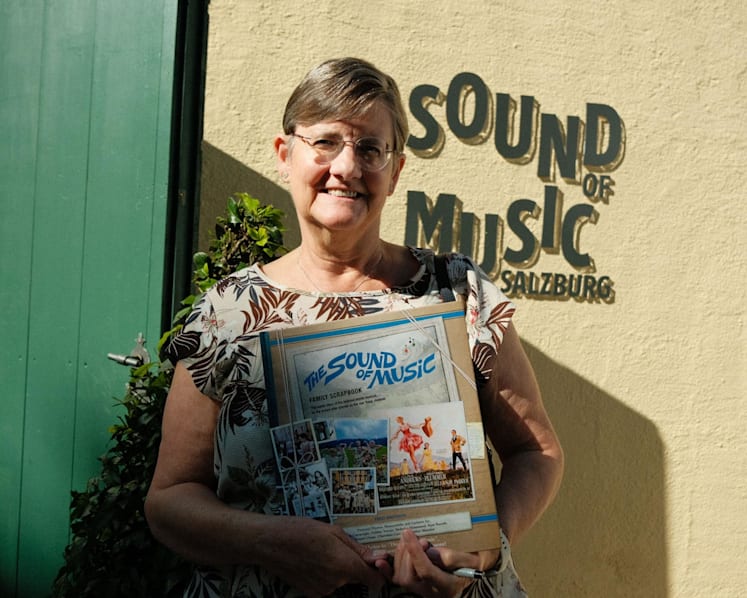 Longtime Sound of Music fan Mireille Bohnen travelled from Antwerp, Belgium, for the museum opening. (Photo: Toh Ee Ming)
“In the 70s, before the internet and Google and everything, I read in an article that the family lived in Stowe, Vermont. So I wrote a letter to Maria, and she sent me back a postcard and an autograph,” she says. Today she screens the film every Christmas for her granddaughters. “You can see it plenty of times without getting bored. It reminds me of my youth.”
At the formal opening in the Salzburg State Theatre, there are speeches and, naturally, songs. The museum curators speak about the sheer scale of the task, from sifting through a mountain of material to wrangling the rights. The hardest part, says co-curator Matthias Bergsmann, was creating a collection “that does justice to both the legend of The Sound Of Music and the history of the von Trapp family.”
Then Hammond reads out a surprise letter from the legendary dame herself, Julie Andrews, who just turned 91. But it is granddaughter Elisabeth von Trapp whose sombre solo leaves the theatre hushed. It’s a reminder of a family uprooted from its homeland that found healing in music.
UP THE MOUNTAINS, INTO THE MEADOWS
Panorama Tours, which ferried the film crew around in 1964, takes us 45 minutes out of town to St Gilgen, the lakeside village glimpsed in the film's opening scenes.
A cable car carries us up the Zwolferhorn to the Von Trapp Family Mini Museum, newly opened in May. Inside are painstaking miniatures of the family and their Vermont lodge. In the distance, paragliders drift over lakes of a startling blue.
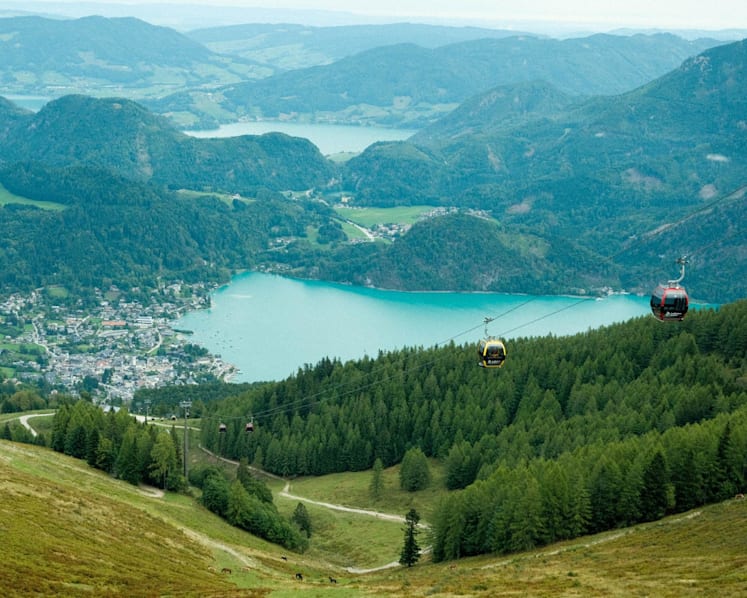 Lakes and peaks unfold below the cable car up the Zwölferhorn near St Gilgen. (Photo: Toh Ee Ming)
Here we're joined by Kristina von Trapp, granddaughter of Maria and the Captain, who runs the 2,600-acre (1,052ha) von Trapp Family Lodge and Resort in Stowe, Vermont. The family settled there in 1942 because its lakes and forests reminded them of home, and the lodge still wears its Austrian heart on its sleeve, from the carved balconies and shingled bell tower to the schnitzel and house-brewed lager. Guests cross-country ski in winter and hike or mountain-bike in summer. “And we always have music on the property,” she adds.
Maria, she recalls, was a strict disciplinarian but kind and generous to guests and staff alike, and it was from her that Kristina learnt to be a hostess.
“Growing up, we didn't know there was anything different about our family,” she says. “All of the hotels in Stowe were family owned and operated, so our job wasn't unusual at all.” She was 11 or 12 when she first saw the film and could not square it with her own life.
“I always refer to the movie as my science fiction parallel universe family,” she says with a laugh. Only at 20, travelling in the far south of Chile, when strangers recognised the name on her credit card, did the scale of it begin to dawn on her.
We make for the slopes in Werfen, 40km south of Salzburg. A Do-Re-Mi trail climbs about 1.5km through the forest to the meadow where Maria teaches the children to sing over a picnic. Along the way, little markers let us spin a wheel or set off a tune. We walk the trail together with Hammond, who narrates the trail's audio guide.
Filming in Austria was like "stepping into a fairytale book," he recalls, and even today, coming back to Salzburg takes him straight back to his childhood. At the top, some visitors twirl with their arms flung wide against the valley. Others are content to flop in the grass.
FREEWHEELING WITH FRAULEIN MARIA
Back in the city, the atmospheric Salzburg Marionette Theatre stages its own Sound Of Music, still one of its most popular productions. And anyone inspired to dress the part can head to shops selling traditional dress, such as Moser and Salzburger Heimatwerk.
My favourite outing, though, is on two wheels with Fraulein Maria's Bicycle Tours, where every bike is stencilled with a name. Mine says Julie Andrews. Our guide, Santino, is a bubbly Australian who once played Rolf in a local production and now teaches primary school, weaving music into maths lessons.
For three hours he leads us through the cobbled old town at a clip, breaking into song with a theatrical skip and tossing out trivia. Christopher Plummer apparently found the whole thing so saccharine he called it The Sound Of Mucus. From the Mirabell Gardens steps, scene of Do-Re-Mi's grand finale, we pass the Residenzplatz fountain that Maria splashes in I Have Confidence, then puff uphill to the red onion dome of Nonnberg Abbey, where the nuns can still be heard singing early in the morning.
Then Santino hands over the speaker and urges us to unleash our inner Fraulein Maria. We freewheel down across wide green meadows with the soundtrack blaring in jaunty fashion and geese flapping overhead, and it is impossible not to be swept up in the joy of it. We pause on the shore across from Leopoldskron, where a wedding party is in full swing. Then we loop back to the museum, a fitting full circle. Visitors are trickling in, taking wefies.
I think back to our guides' stories, of three generations travelling together, some in tears on the bus, and of people who put the film on whenever life gets hard. In her letter, Andrews said that the most remarkable thing was not the box office success, or even strangers who still break out into Do-Re-Mi when they spot her at airports, but that the story endured. It began, she wrote, "with the real family, living through a very dark and difficult moment in history."
Today, it remains a timeless tale of love and family, of resilience and hope, that still crosses every border. When times are hard, it's a reminder to hold your head high and keep singing anyway.
CNA Lifestyle was in Salzburg at the invitation of Salzburg Tourism. SoulTrips offers custom and guided Sound of Music tours.






 English (US) ·
  Turkish (TR) ·