
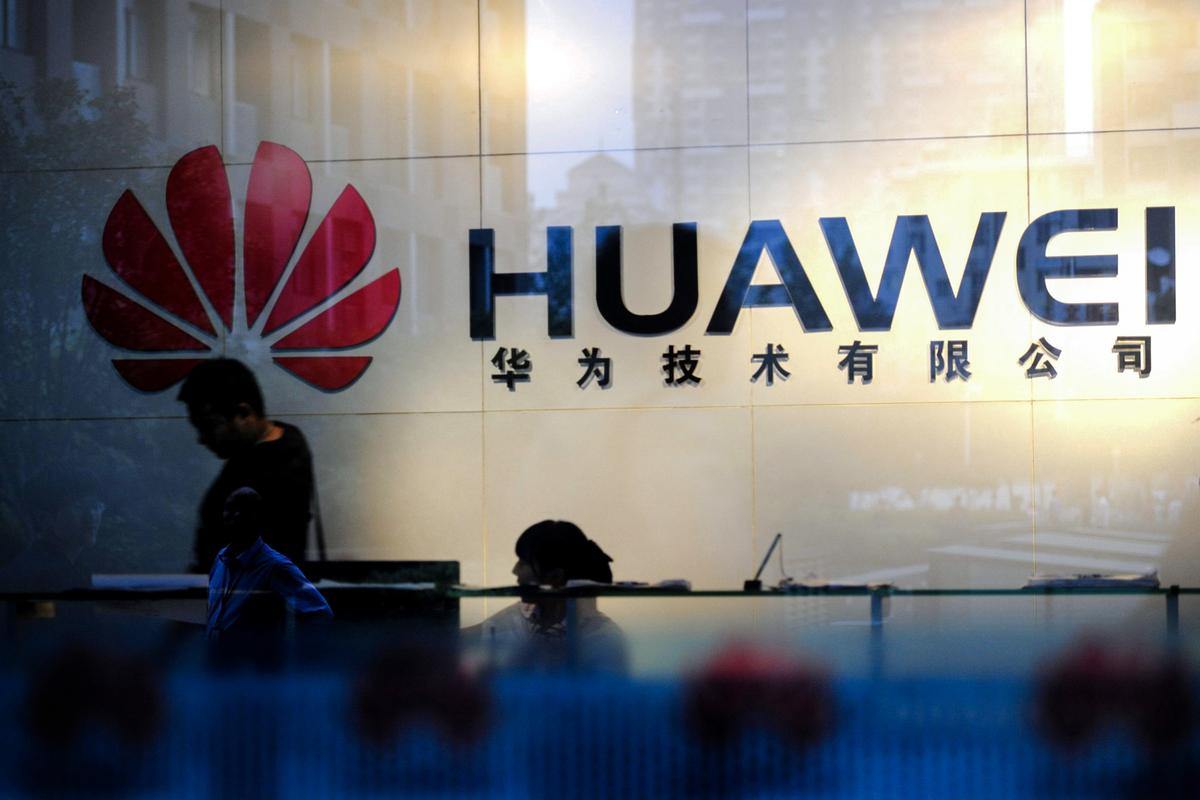
Staff and visitors walk past the lobby at the Huawei office in Wuhan, Hubei Province, China, on Oct. 8, 2012. STR/AFP/Getty Images
Huawei Technologies heads to jury selection on Tuesday in a federal racketeering case alleging a years-long scheme to steal U.S. technology and conceal dealings with Iran and North Korea.
Jury selection was scheduled before U.S. District Judge Ann Donnelly in Brooklyn, New York. The trial will begin on Wednesday.
The defendants listed by the court also include three Huawei subsidiaries—Huawei Device Co., Huawei Device USA and Futurewei Technologies—and Skycom Tech, a Hong Kong-registered company that prosecutors allege functioned as Huawei’s subsidiary for its Iran operations.
The defendants face 14 counts, including racketeering conspiracy, conspiracy to steal trade secrets, bank and wire fraud, sanctions-related offenses, money laundering conspiracy, and conspiracy to obstruct justice, according to a July court order describing the current charges. Huawei has pleaded not guilty.
Prosecutors expanded the case in February 2020 with a superseding indictment that laid out the racketeering allegations and detailed Huawei’s alleged efforts to obtain competitors’ technology.
Alleged Effort to Obtain Competitors’ Technology
Federal prosecutors allege Huawei sought intellectual property from six U.S. technology companies over nearly two decades.
The February 2020 indictment describes internet-router source code, cellular antenna technology, robotic phone-testing equipment, and other proprietary information. Prosecutors allege Huawei used confidentiality agreements, competitors’ employees, and third parties to obtain nonpublic information.
The indictment also alleges that Huawei adopted a policy in 2013 to reward employees for obtaining confidential information from competitors.
One episode involved T-Mobile’s smartphone testing robot. Prosecutors allege that Huawei employees photographed and measured the device and that an employee removed part of it from a T-Mobile laboratory in 2013 before returning it.
Skycom, Iran, North Korea
Prosecutors allege that Huawei controlled Skycom while portraying it as an independent business partner.
Huawei Chief Financial Officer Meng Wanzhou in 2021 entered into a deferred prosecution agreement, which included signing a statement of facts admitting that she had falsely told a bank executive that Huawei had sold its Skycom shares and that Skycom was merely a business partner.
The Justice Department said Huawei caused Skycom to conduct about $100 million in U.S.-dollar transactions through the financial institution between 2010 and 2014, with at least some supporting Huawei’s business in Iran in violation of U.S. law.
The indictment separately accuses Huawei of concealing its business in North Korea. According to prosecutors, internal Huawei documents referred to North Korea as “A9.”
Huawei sought to dismiss much of the case before trial, challenging the reach of U.S. criminal law over conduct abroad. Donnelly denied the motion in July 2025, allowing the racketeering, trade-secret, financial-fraud, and sanctions-related charges to proceed.
In a June order made public in July, Donnelly also rejected Huawei’s effort to suppress four laptops, two recordings, and evidence derived from them.
This story will be updated with additional details.

 English (US) ·
  Turkish (TR) ·