
At a traditional Chinese martial arts competition in the Manhattan borough of New York City, competitors who had spent years practicing barehanded forms and weapons such as swords and spears repeatedly returned to a lesson that had little to do with defeating an opponent.
They called it “wude”—martial virtue.
For silver medalist Jin Huan, it means learning how to conduct oneself before learning how to fight.
“If you want to make progress in martial arts, you definitely have to cultivate your character,” Jin told the Chinese edition of The Epoch Times. For her, practicing martial arts also means holding oneself to the standard of becoming a better person.
Jin was among the competitors at the ninth NTD International Traditional Chinese Martial Arts Competition, whose finals concluded in New York on Aug. 15.
For many of them, wude meant something concrete: practicing consistently, respecting teachers and fellow students, helping others improve, restraining the urge to fight, and treating a medal as less important than becoming better than they were before.
More Than Technique
Martial virtue is built into the competition itself.
NTD’s published rules say contestants are judged on whether their performances retain the characteristics of traditional martial arts, including posture, coordination, technique, power, breathing, concentration, and rhythm.
The rules also require proper martial arts etiquette and place martial virtue at the top of the expected conduct for contestants. Improper behavior can result in disqualification. NTD’s stated mission similarly calls for humility, kindness, righteousness, respect for teachers, and less attachment to fame and personal gain.
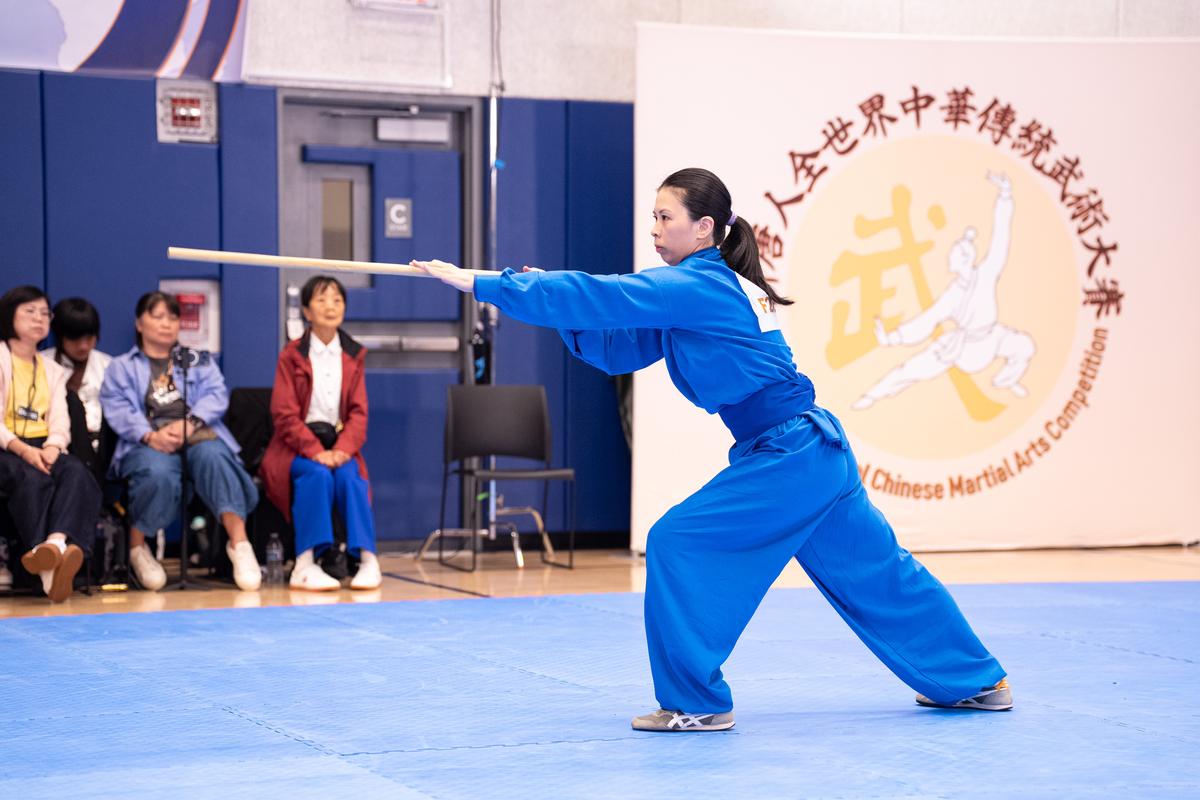
Jin Huan of the United States competes in the women's weapons final in Manhattan on Aug. 15, 2026. Jin won silver. Dai Bing/The Epoch Times
Li Youfu, chair of the competition’s judging panel, told The Epoch Times judges have raised their technical standards in recent competitions while also asking practitioners to improve their martial virtue.
The two, in his view, should develop together. Li urged martial artists to put improving their wude first.
For competitors, those principles often became personal tests long before they stepped in front of the judges.
Competing Against Yourself
Jin, who won silver in the women’s weapons division, told The Epoch Times her understanding of training changed between her first appearance at the competition and this year’s event.
At the earlier competition, she said, she learned that martial arts demanded discipline: Had she really practiced every day? Had she practiced seriously and correctly rather than simply going through the motions?
She resumed training the day after that competition ended.
This year brought another question: Was she breaking through her own limitations each time she practiced?
Jin said martial virtue also manifests in the way students treat one another. She recalled how her classmates supported her and applauded when she successfully performed a difficult jumping movement after struggling with it for some time.
Even when busy, she said, students would help one another. Putting others first, she said, was itself part of learning wude.
Although she left this year’s competition with a silver medal, she said the award was encouragement rather than the purpose of training.
Strength With Restraint
Lin Jingyao, a practitioner from Taiwan who competed in Seven Star Praying Mantis boxing, said his understanding of martial arts changed over years of training.
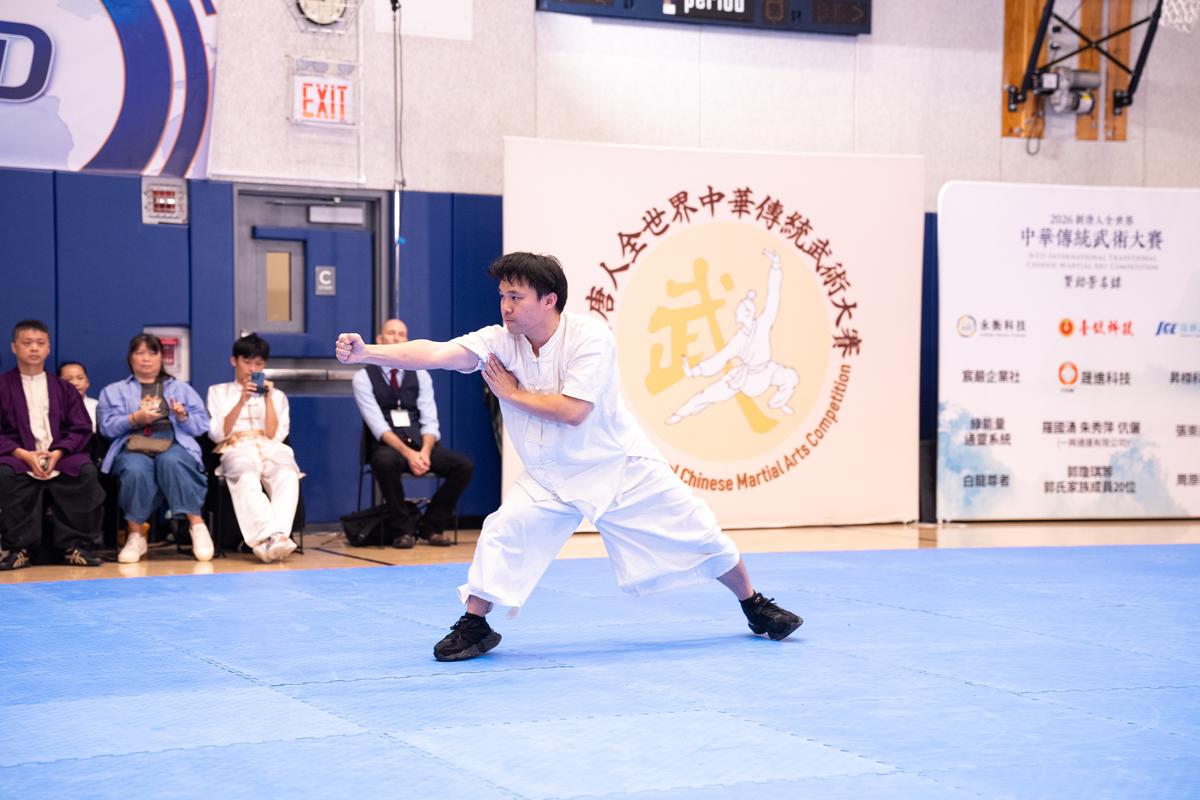
Lin Jingyao of Taiwan performs a Seven Star Praying Mantis form in the men's barehanded division final in Manhattan on Aug. 15, 2026. Dai Bing/The Epoch Times
Early training built toughness and taught him to endure hardship, he said. With more experience, however, he began to think less about improving his techniques alone and more about improving himself.
“Kung fu is for cultivating yourself, not for attacking other people,” Lin told The Epoch Times. “That is what we call martial virtue.”
Sixteen-year-old Liang Songqi of Taiwan, who won silver in the junior weapons division with a miaodao, a Chinese two-handed saber, described wude as a standard for everyday conduct.
Liang began training at age 9, initially because he wanted to learn self-defense. As he grew older, he said, stories his teachers told about historical figures began to make more sense to him.
Martial virtue, he told The Epoch Times, is like a framework that gives a person boundaries and a standard toward which to strive.
He credited that approach with changing how he deals with other people, saying he now gets along better with classmates and friends and is less prone to conflict.
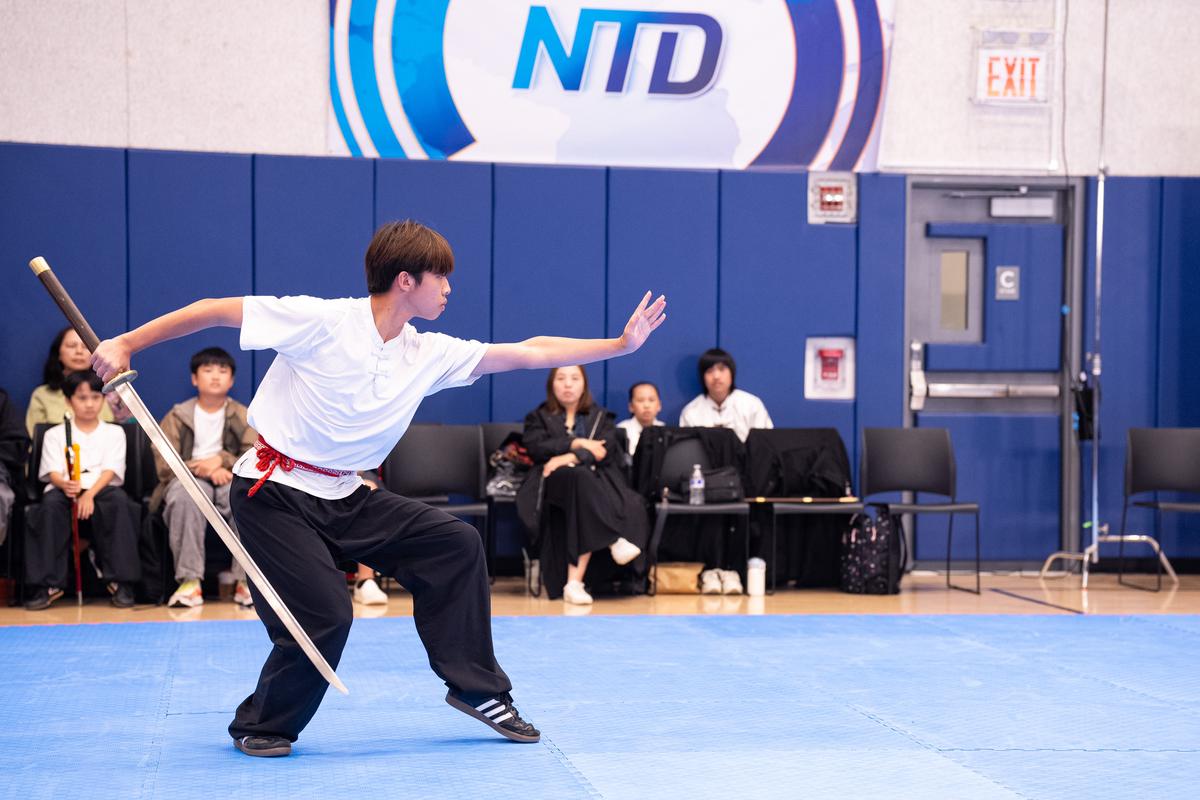
Liang Songqi of Taiwan performs with a miaodao in the junior weapons semifinal in Manhattan on Aug. 14, 2026. Dai Bing/The Epoch Times
The competition tested him in another way.
It was his first time traveling abroad alone to compete, and Liang acknowledged worrying about whether his name would appear when finalists and winners were announced.
By the end, he said the larger achievement was having made the trip and crossed a threshold he had set for himself.
Regardless of the result, he said, getting there had already mattered.
Learning to Slow Down
For Wu Jiarou of Taiwan, more than a decade of practicing with a spear taught an unexpected lesson: slowing down.
Wu began learning traditional martial arts at about age 10. She chose the spear and continued practicing it for more than a decade.
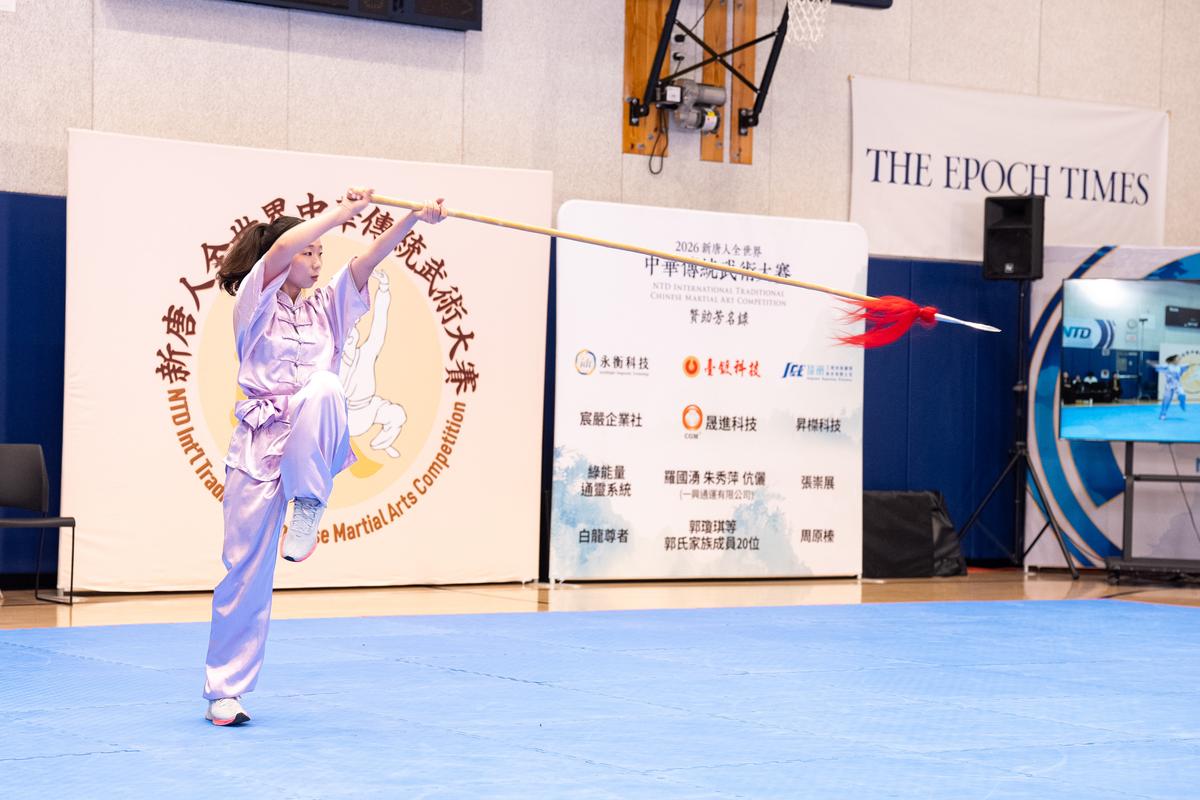
Wu Jiarou of Taiwan performs the Six Harmonies Spear in the women's weapons semifinal in Manhattan on Aug. 14, 2026. Dai Bing/The Epoch Times
As her technique improved, she said, she found that concentrating on the weapon quieted outside distractions.
“Learning martial arts can make me slow down and not be so rushed,” Wu told The Epoch Times.
That lesson carried into her work in psychological counseling.
Wu said she became less inclined to immediately offer clients advice and more willing to listen patiently and give them time to work through difficulties.
Competition also changed for her. She once focused heavily on rankings, she said, but over time became more interested in her own development than in where she placed.
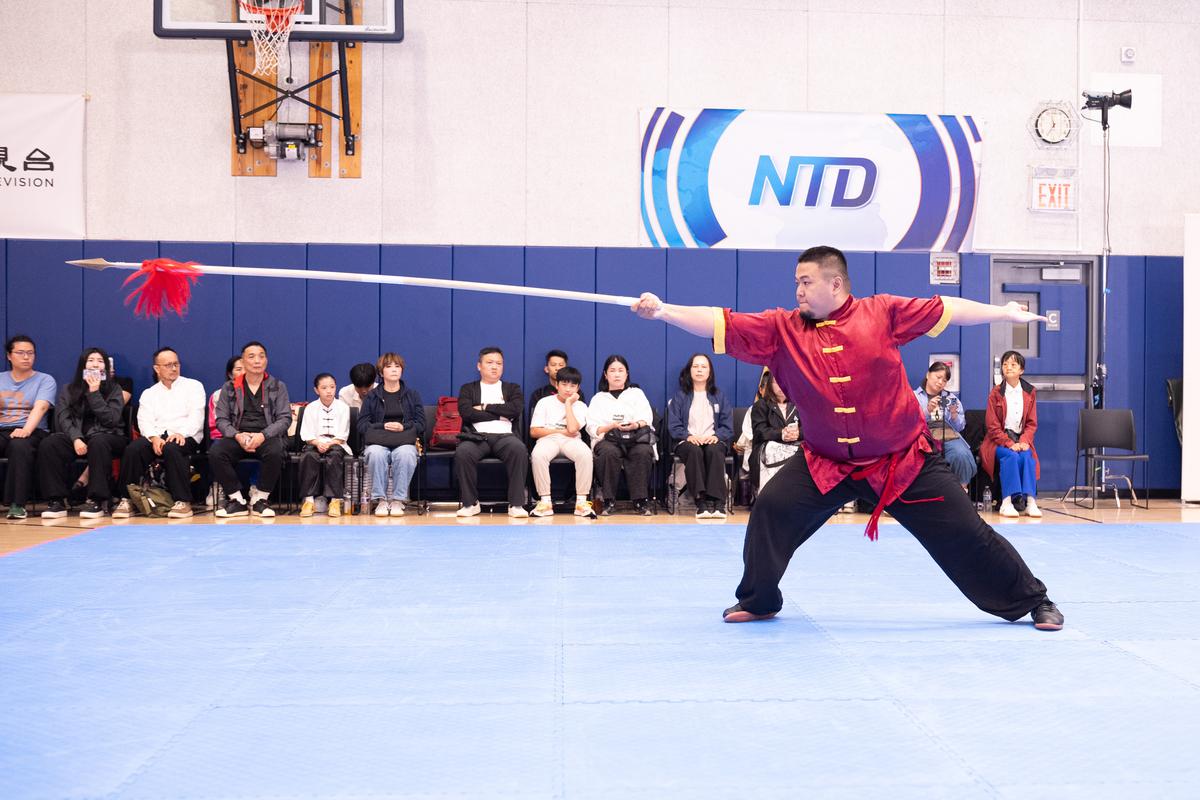
Chen Shaoxuan of Taiwan performs the Shaolin Great Six Harmonies Spear in the men's weapons final in Manhattan on Aug. 15, 2026. Dai Bing/The Epoch Times
Getting Back Up
For Taiwanese martial arts teacher Han Jixiang, the idea of mastering oneself was tested before he ever reached New York.
Han, a third-generation inheritor of Han-style martial arts, had agreed to accompany his 11-year-old daughter, Han Aini, to the competition after she told him she wanted to take part. He also planned to visit an 86-year-old aunt in the United States who had helped teach him martial arts years earlier.
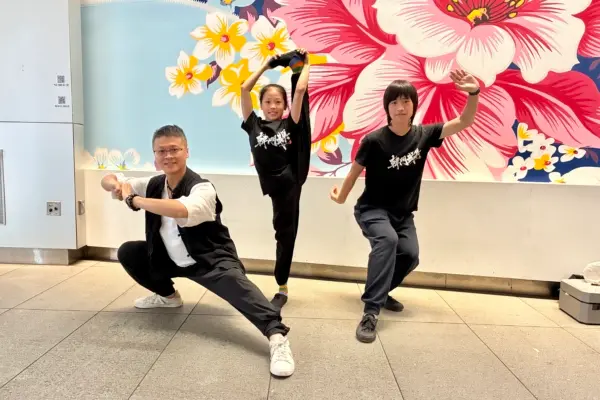
Martial arts teacher Han Jixiang (L) with his daughter, Han Aini (C), and student Chen Yinheng at the 2026 NTD International Traditional Chinese Martial Arts Competition. Ye Zhen/The Epoch Times
About a month before the trip, a medical examination found early-stage colon cancer, Han told The Epoch Times.
He underwent surgery that removed about 3.1 inches of his intestine. Weakened afterward, he said he began his rehabilitation by learning to stand again and gradually worked his way back.
People around him urged him to abandon the competition and focus on recovering. Han said he assessed his condition and decided to keep the promise he had made to his daughter.
By the time he reached New York, he could again complete a martial arts form, although he was still being careful with some movements less than a month after surgery.
The experience changed what competition meant to him.
Han recalled a lesson from his teacher: “Your biggest enemy is never someone else. It is always yesterday’s self.”
Winning or losing, Han said, was no longer the main point. What mattered was how a person faced himself after falling and found the courage to stand again.
Han ultimately won silver in the men’s weapons division. His daughter won silver in junior barehanded forms, while his 15-year-old student, Chen Yinheng, won bronze.
Yuli Li, Ping Shi, and Zhen Ye contributed to this report.







 English (US) ·
  Turkish (TR) ·