
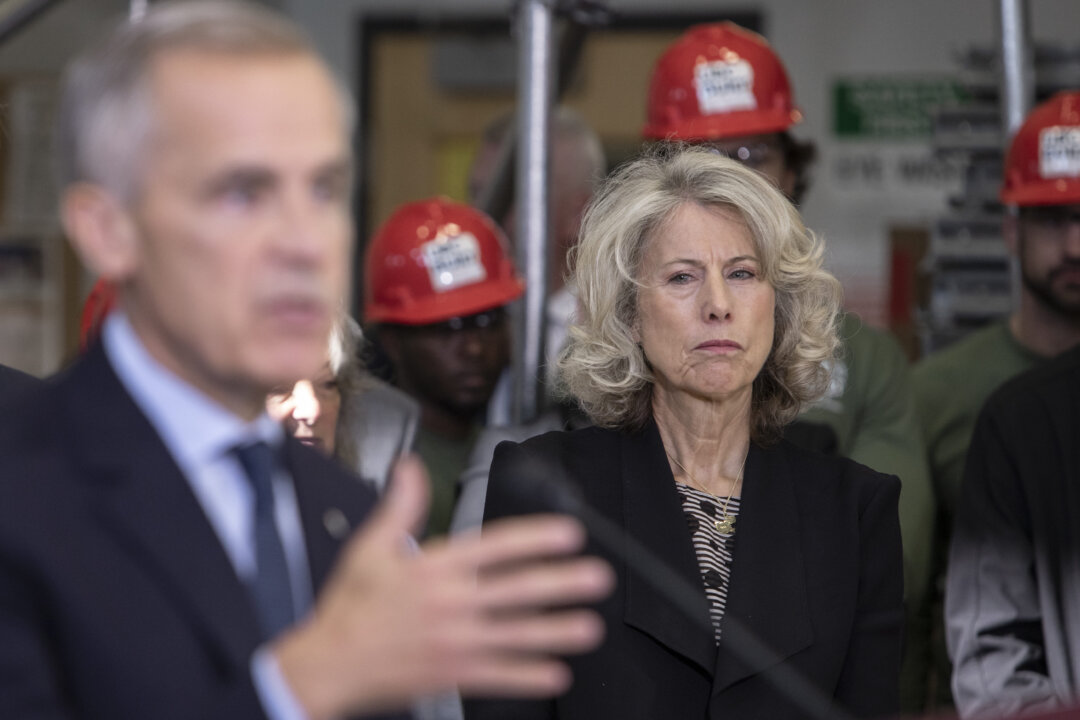
Prime Minister Mark Carney says he plans to raise the issue of foreign interference with Chinese leader Xi Jinping when the two meet next week at the Asia-Pacific Economic Cooperation (APEC) summit in Shenzhen, China.
Carney made the comments Nov. 10 on Parliament Hill when asked by reporters about a recent report by human rights organization Safeguard Defenders that says the Chinese Communist Party (CCP) continues to operate a network of liaison points across Canada, including police stations, despite previous efforts by the RCMP to shut down these suspected sites of foreign interference and transnational repression.
The report identifies more than a dozen such points in Canada and says they form part of a broader network used by Beijing to monitor and exert influence over Chinese diaspora communities abroad.
“It will be an opportunity for us to have frank and open conversations with [Xi] about security issues, about economic issues as well,” Carney said of the APEC Leaders’ Meeting, scheduled for Nov. 18 and 19.
“There will be an opportunity to strengthen the importance of not allowing foreign interference in Canada. I will raise that with him,” Carney added.
The prime minister also said he would discuss the importance of China and “other countries” not interfering in Canada’s domestic affairs at the APEC meeting. He suggested that the security risks associated with Canada’s relationship with China were considerably lower than those facing the United States in its relationship with Beijing.
“For security risks, in terms of our relationship with with China, the risks are much lower than … the risks between China and the U.S.,” he said in French.
China-Canada Relations
The recently released Safeguard Defenders report raises concerns over ongoing CCP interference in Canada, and comes amid a series of steps taken by Ottawa and Beijing to deepen ties.
Most recently, China issued 4 billion yuan (approximately CA$846 million) in green sovereign bonds in Canada on Nov. 9, expanding financial ties between the two countries. The bonds are intended to support environmentally beneficial projects, according to China’s Ministry of Finance, and will be listed on the Hong Kong Stock Exchange.
The issuance also supports Beijing’s efforts to promote wider international use of the yuan and reduce dependence on the U.S. dollar.
Former Canadian national security analyst Dennis Molinaro warned that the new arrangement means there’s now a G7 country “hosting China’s push” against the U.S. dollar, and that it ties “Canadian institutions to China’s economy in a way that trade alone never could.”
The bond issuance coincided with the second Canada-China Economic and Financial Strategic Dialogue, held in Vancouver on Nov. 8 and 9. The meeting was co-chaired by Chinese Vice-Premier He Lifeng, Finance Minister François-Philippe Champagne, and International Trade Minister Maninder Sidhu.
Earlier on Nov. 4, Sidhu announced that Canada and China had agreed to extend a trade arrangement until the end of 2028, rather than allowing it to expire at the end of 2026. Under the extension, China will continue providing favourable market access for Canadian canola meal, peas, lobster and crab. Canada, in return, agreed to extend tariff-remission measures for certain Chinese steel and aluminum products that are not manufactured in Canada.
China analyst Vina Nadjibulla said on social media the extension of the agreement “clears” the way for Carney’s APEC trip to focus on Chinese investment and the overall relationship. However, she warned that Ottawa’s trade decisions involving Beijing could also affect negotiations with the United States, particularly over steel and aluminum.
In Budget 2025, Carney’s government set a goal of doubling Canada’s exports to markets outside the United States by 2035. During a visit to China in January 2026, Carney also committed to increasing Canadian exports to China by 50 percent by 2030.
During the same visit, Carney said progress in the Canada-China partnership “sets us up well for the new world order.” The remark came after he described China during the 2025 federal election campaign as Canada’s biggest national security threat.
Carney’s January visit also resulted in several memoranda of understanding with Beijing, including agreements on closer law-enforcement co-operation. The two countries also reached an arrangement allowing up to 49,000 Chinese-made electric vehicles (EVs) to enter Canada in the first year at a reduced tariff rate.
Ottawa and Beijing also held their first military talks since 2018 on Sept. 4 of this year in Victoria. The Canadian Armed Forces said the meeting was a working-level dialogue and said defence cooperation was not part of Ottawa’s approach. China’s Ministry of National Defense said both sides had expressed a willingness to strengthen practical exchanges and co-operation between their militaries.
The Conservatives have criticized Ottawa’s deepening ties with Beijing, including the military dialogue, the reduced tariff arrangement for Chinese EVs, and the trade agreement covering Canadian agricultural and seafood exports. Conservative Leader Pierre Poilievre has said Ottawa should be focusing on repairing ties with the United States instead of seeking a closer relationship with Beijing.
The Tories have also raised concerns about Ottawa’s security-screening procedures following the July 24 arrest of a Canadian national of Chinese origin on espionage-related charges in Belgium.
Belgian authorities allege the woman, who was interning at NATO’s military headquarters in Mons, was spying for China and participating in a criminal organization. The allegations have prompted questions about how she obtained security clearance to work at the military headquarters





 English (US) ·
 Turkish (TR) ·
