
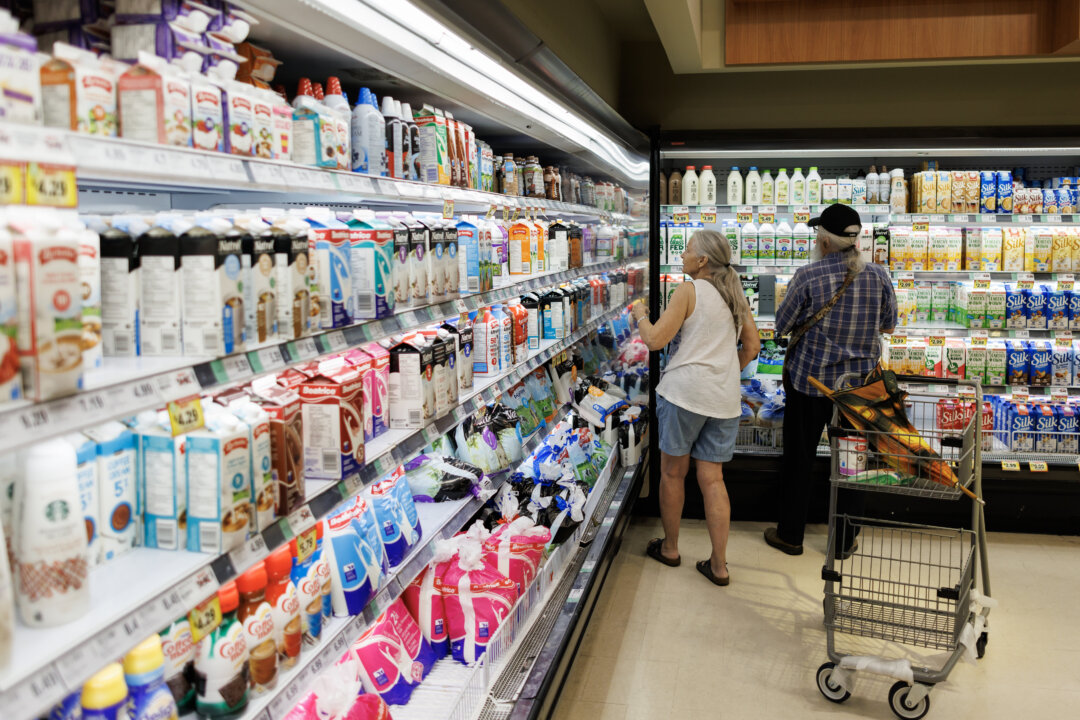
Canadian families could see their annual grocery bills jump $1,000 next year if diesel prices remain elevated, a top food economist is warning.
Dalhousie University Agri-Food Analytics Lab senior director Sylvain Charlebois told the House of Commons human resources committee that escalating fuel costs are likely to drive food prices higher in the next six to 12 months.
He told the committee during his testimony on Oct. 29 that these prices quickly impact the cost of farming, processing, and transportation.
“Our lab scenario indicates that if high diesel prices persist through winter, grocery inflation could peak 0.5 to 0.7 percentage points above an easing baseline,” said Charlebois, who described the increase as “significant.”
“That represents basically about $700 to $1,000 more to spend on groceries for the average household in Canada,” he said.
The food supply in Canada is particularly vulnerable to rising diesel prices due to the country’s heavy reliance on trucking, Charlebois said.
“We have a trucking economy,” he added.
The 2026 edition of the Agri-Food Analytics Lab’s Food Price Report said a typical family of four would spend $17,572 on food and groceries annually. The total represented an increase of nearly $1,000 compared to the previous year’s baseline.
Charlebois said the lab is currently preparing the 17th edition of Canada’s Food Price Report, which is scheduled for official release on Dec. 3.
Beyond the cost of diesel, Charlebois also listed the Canadian dollar as an inflationary issue. He said a weaker Canadian dollar drives up grocery prices because Canada relies heavily on imported fresh produce—particularly during the winter months.
He said the Canadian dollar’s value of 68 U.S. cents could push fruit price inflation to 4 percent and vegetable price inflation to 5.5 percent.
These factors combined with disrupted rainfall and harvests driven by super El Nino, which is expected to persist through February 2027, will impact food costs, he said. Historically, these factors impact Canadian grocery shelves with a six- to nine-month delay, meaning higher processing costs will filter into 2027 bread, pasta, and snack prices.
Charlebois described Canada as having a “price volatility issue.”
“The problem is that for 17 months, from one month to another, prices dropped and then went up again,” he said, but noted it has been an ongoing issue off and on for the past five years.
This scenario has pushed many Canadians to use food banks, he said, noting that this applies just as much for those who are working as for those on assistance.
“There is a term, working poor,” said Charlebois. “A lot of Canadians actually go to food banks and they are working. They have one, two, sometimes three jobs, and so the lower 40 percent are forced to either trade down at the grocery store or seek help at a food bank.”
That downgrading means shopping at “the centre of the store” where the boxed and canned foods are located, Charlebois said. High price fluctuations mean some shoppers can’t afford to shop for the “fresh, more nutritionally desirable” foods.
He said Canadian shoppers have seen so much volatility over the past five years “it is impossible for them to know” if they can afford groceries.
“The challenge that we have in Canada is that we can’t really stabilize inflation over time,” he said. “We do see huge ups and downs, which is really making a lot of Canadians concerned about food prices in general.”







 English (US) ·
 Turkish (TR) ·
