
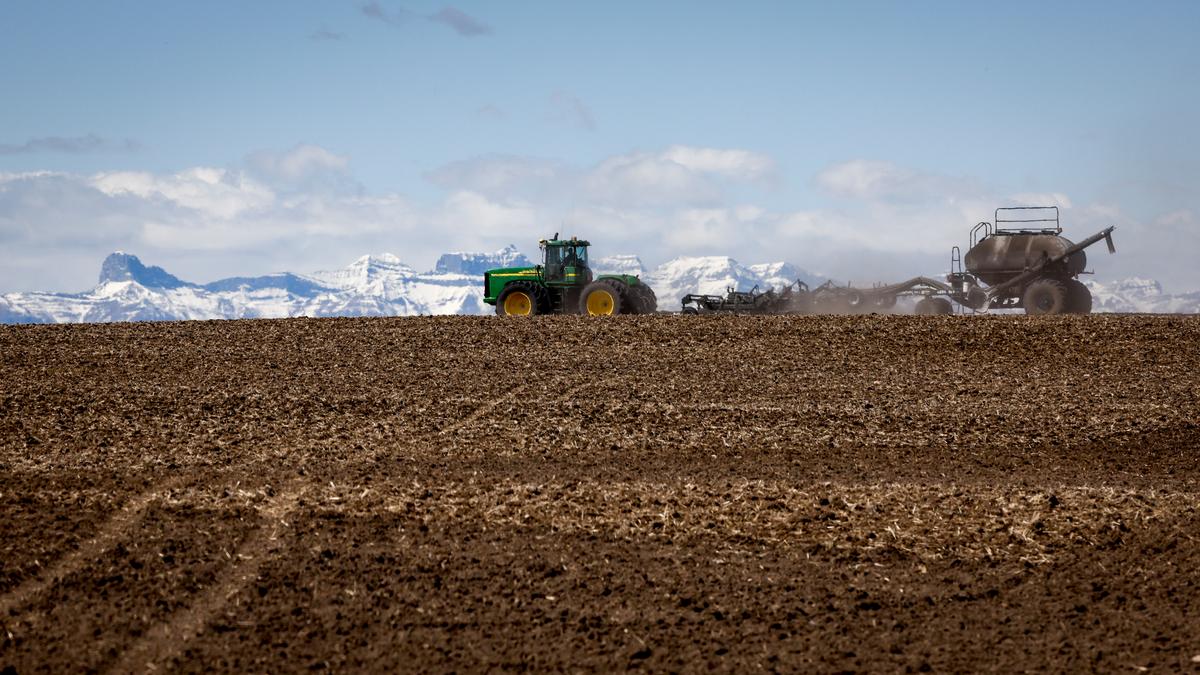
A family plants their wheat crop with a seeding rig, near Cremona, Alta., on May 6, 2022. The Canadian Press/Jeff McIntosh
Prince Edward Island, Quebec, Alberta, and Manitoba recorded the largest increases in farmland values in the first half of 2026, as regional conditions shaped the market, a new report says.
Cultivated farmland values across Canada rose 3.8 percent between January and June, down from a 6.0 percent increase during the same period in 2025, according to Farm Credit Canada’s (FCC) recent mid-year review.
Values increased 7.0 percent year-over-year through June, compared with 9.3 percent growth over the full 2025 calendar year.
The report said farmland values remained “far from ‘dirt cheap,’” despite slower growth. Local supply and demand, rising production costs, and uncertainty surrounding trade, tariffs, and international markets continued to influence prices.
Prince Edward Island led the provinces in farmland value growth in the first half of 2026, with values rising 11.9 percent, compared with 8.5 percent during the same period in 2025.
Recent sales in Prince Edward Island provided clearer evidence “of an upward movement that has been building over time,” the report said, noting that stronger sales and narrower sale price ranges provided firmer support for the increase and a higher market average.
Quebec recorded the second-highest increase, at 6.2 percent, up from 4.8 percent in the first half of 2025. Alberta and Manitoba each recorded 5.3 percent growth, followed by Nova Scotia at 3.6 percent, Saskatchewan at 2.6 percent, Ontario at 2.4 percent, and New Brunswick at 2.1 percent.
British Columbia was the only province to record a decline, with farmland values falling 1.9 percent in the first half of 2026, compared with a 1.7 percent drop during the same period in 2025.
The report said growth momentum had shifted toward the Prairie provinces, particularly Alberta, while Ontario and British Columbia had “experienced the sharpest normalization.”
“Canada’s cultivated farmland market remains resilient, though growth has moderated,” the report said.
“Demand is strongest for productive, well-located land, while higher input costs, tighter margins and regional supply constraints are making buyers more selective.”
FCC collects farmland value data every six months, allowing it to track historical changes. The report compares year-over-year growth rates since June 2020 to show how current growth rates differ from their peaks during that period.
Alberta’s year-over-year farmland value growth rate peaked at 11.4 percent in December 2025 before easing to 9.4 percent in June 2026, a decline of 2 percentage points.
By June 2026, Quebec’s growth rate had fallen 5.6 percentage points from its June 2021 peak of 13.7 percent. British Columbia’s rate declined 22 percentage points from its December 2021 peak of 18.1 percent, while Ontario’s fell 24.5 percentage points from its June 2022 peak of 27.7 percent.
Nationally, the year-over-year growth rate declined 6.1 percentage points from its June 2022 peak of 13.1 percent to 7.0 percent in June 2026.








 English (US) ·
  Turkish (TR) ·