
 2 hours ago
43
Accusations of foul play are flying as Lula takes on Bolsonaro in a battle with global consequences for Latin America and the BRICS group
Brazilian President Luiz Inacio Lula da Silva is once again fighting for his political future, in a runoff election against Flavio Bolsonaro, the son of jailed former President Jair Bolsonaro. After a dirty campaign, voters will decide on Sunday whether Brazil maintains its leftward trajectory or lurches to the right.
Bolsonaro defeated Lula in the first round of this year’s presidential election, beating the incumbent left-winger by 47.03% to 45.16% on October 5. With neither candidate winning an outright majority, ten runners-up were eliminated and a runoff called for October 25.
Who are the candidates?
Luiz Inacio Lula da Silva, more commonly referred to as ‘Lula’, has been a mainstay in Brazilian politics since the 1980s. After serving two terms as president from 2003 to 2011, he was sentenced to nine years in prison in 2017 for alleged involvement in a corruption and money laundering scheme within the state-run oil company Petrobras.
Brazil’s Supreme Federal Court struck down his conviction in 2021, and Lula returned to politics the following year, defeating Jair Bolsonaro by a margin of just 0.11%. In power, Lula has increased government spending to tackle poverty, handed subsidies to industry, and hiked taxes on the wealthy. Meanwhile, his government has deepened trade and diplomatic ties with Russia, China, and the rest of the BRICS group, while criticizing US intervention in Latin America.
“Brazil,” he said in a speech at the UN General Assembly last month, “does not fit into anyone’s back yard.”
A senator since 2019, Flavio Bolsonaro is the eldest son of Jair Bolsonaro, who was placed under house arrest last year after the Supreme Federal Court found him guilty of attempting to overturn his 2022 loss to Lula. A social conservative, Flavio Bolsonaro has promised to slash government spending, deregulate industry, crack down on crime, and rein in the power of the judiciary. If elected, he has promised to pursue amnesty for his father.
Bolsonaro favors closer relations with the US, and has said he would join US President Donald Trump’s military campaign against Latin American drug cartels. He has signaled he would “consider leaving” BRICS, accusing the organization of “provoking the United States by proposing that the dollar should no longer be the currency for international transactions.”
Should Bolsonaro win, he would fall into a growing camp of right-wing leaders in Latin America, including Presidents Javier Milei of Argentina, Abelardo de la Espriella of Colombia, Jose Antonio Kast of Chile, and Nayib Bukele of El Salvador.
What are the key issues?
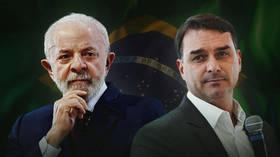
Crime is the dominant issue in this election, with 28% of respondents telling CNN Brazil that “violence” is the main problem facing the country. Bolsonaro, who has pledged to designate drug trafficking gangs as terrorists, relax restrictions on police violence, and build a network of high-security prisons modeled on El Salvador’s CECOT facility, enjoys a 10-point polling advantage over Lula on this issue, according to a Bloomberg survey.
CNN Brazil identified “corruption” as the second issue atop voters’ list of concerns. Bolsonaro also leads Lula on fighting corruption, according to Bloomberg, albeit by a smaller margin of 4%.
Bolsonaro is currently a subject in two money laundering probes, but he has fired off corruption accusations at Lula, citing the involvement of Supreme Court Justice Alexandre de Moraes in one of these investigations. Moraes, a close political ally of Lula and the man responsible for jailing Bolsonaro’s father, was accused of taking bribes from the banker at the center of the probe.
Economic concerns are the third most pressing issue for voters, according to the CNN poll. Lula has made his economic record a central pillar of his campaign, pointing to Brazil’s rising wages, falling unemployment, and modest economic growth during his tenure. The president enjoys a narrow lead over Bolsonaro when it comes to tackling poverty and inequality, but Bolsonaro is seen as a stronger candidate when it comes to taming inflation and reducing Brazil’s national debt, according to Bloomberg’s poll.
Who’s interfering in the election?
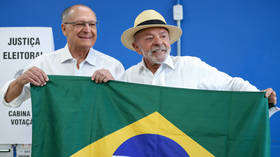
The election has descended into a bitter battle over foreign interference, censorship, and dirty tricks. Earlier this month, Lula’s campaign accused Mark Zuckerberg’s Meta of intervening against him by throttling his posts and preventing him from boosting his advertisements on Instagram. Days before the first round of voting, Meta also blocked the Lula campaign’s advertising account on Facebook, preventing it from running new ads.
Meta claims that technical problems were to blame, and insists that any allegations of favoritism are “simply false and unsupported by the facts.” Whatever the explanation, Meta’s platforms are vital to both Lula and Bolsonaro, as other social media platforms – among them Google, TikTok, and X – have banned political advertising in the runup to the election.
Brazilian Attorney-General Jorge Messias has accused the US of election meddling, pointing to the White House’s awarding of a $1 million grant to right-wing groups “countering lawfare and censorship in Brazil” – essentially groups opposing Brazil’s Supreme Federal Court.
“Disagreements between governments are inherent to international relations,” Messias wrote on X earlier this month. “What cannot be tolerated is for foreign political interests to seek to interfere in the functioning of Brazilian institutions or to influence, directly or indirectly, choices that belong exclusively to the Brazilian people.”
Bolsonaro’s supporters view the court as a political instrument in the hands of Lula. Justice Moraes ordered the mass suspension of social media accounts over the spread of so-called “misinformation” in the runup to the 2022 election, with the overwhelming majority of accounts suspended being pro-Bolsonaro ones.
One day after the first round of voting this year, Moraes issued an arrest warrant for Bolsonaro’s brother, Eduardo, who lives in the US. Eduardo Bolsonaro had lobbied the Trump administration to campaign for his father’s release from house arrest.
Bolsonaro has accused Lula of using the machinery of state to boost his campaign. Bolsonaro’s lawyers have called for Lula’s disqualification over his use of the government’s Gov.br system to promote his social programs, his use of government databases to obtain citizens’ contact information in order to send campaign messages, and his use of public funds to produce campaign videos.
What do the polls say?
Lula and Bolsonaro are neck-and-neck in the polls, with every major survey taken up to this month within a margin of error. According to a Quaest poll released after a televised debate between the candidates on Sunday, Bolsonaro leads the leftist incumbent by 45% to 44%. Another poll by PoderData places both candidates in a 50-50 dead heat.
Although the race is too close to call, one historic constant is likely troubling the Lula campaign: since Brazil introduced presidential runoffs in 1989, no candidate has ever won a runoff after losing the first round. However, the first-round gap between Lula and Bolsonaro this month was the smallest in Brazilian presidential election history, at just 1.87%.
With his family persecuted – as he sees it – by Lula’s judiciary, the election is deeply personal for Bolsonaro. For Lula, who is 80 years old, this runoff may be the last of his political career, and the last chance to preserve the leftist state and multipolar foreign policy he’s spent decades building. Whoever wins, this election will be watched in Washington, Moscow, and beyond.
When will we know the result?
Polls close in Brazil at 5 PM Brasilia Time (10 PM Central European Time) on Sunday, and results will begin to emerge around an hour later as ballots are counted. A winner will likely become obvious within hours – in 2022, Lula’s victory was confirmed less than three hours after polls closed.
For more on the election and analysis of the results, stick with RT.






 English (US) ·
 Turkish (TR) ·
