

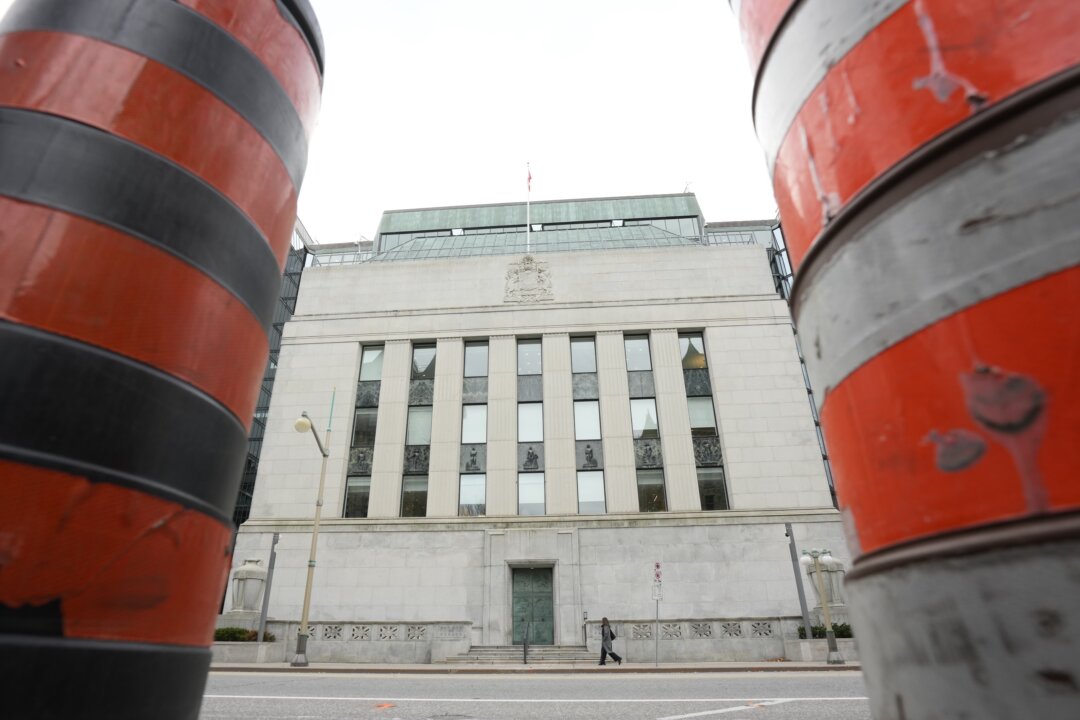
A person walks past the Bank of Canada in Ottawa, on Oct. 28, 2026. The Canadian Press/Adrian Wyld
The Bank of Canada says it may raise interest rates again, but will proceed cautiously amid uncertainty over the economic outlook and conflict in the Middle East.
The central bank raised interest rates to 2.5 percent from 2.25 percent at its Oct. 28 governing council meeting, citing concerns that energy prices could accelerate inflation, according to a meeting summary released on Nov. 10.
Canada’s annual inflation rate hit 3.1 percent in September, above the bank’s 2 percent target. The bank expected inflation to reach 3.5 percent by the end of this year and remain above 3 percent through much of 2027, before declining to 2 percent by mid-2028.
Members of the governing council said the latest interest rate increase was meant to reduce the risk that “persistently high energy prices” would lead to broader price increases in goods and services.
The report noted that members acknowledged “considerable uncertainty” in developments outside Canada and their effects in the country.
“They recognized that uncertainty did not mean inaction, but they agreed they would need to proceed carefully to assess how economic developments would affect their outlook,” the meeting summary said.
“Governing Council members agreed there could be a need to increase the policy rate further, but given the uncertainty, they would take monetary policy decisions one meeting at a time with the benefit of the best available information,” the report added.
Policy Considerations
The report said the members discussed the risks and implications for the Bank of Canada’s monetary policy in light of inflation and the continued trade dispute with the United States.
With the war in the Middle East in its eighth month and no resolution in sight, the council discussed whether a higher policy rate was needed to limit the risk of energy costs spreading to other goods and services.
“A higher-for-longer oil price scenario comparable to the one outlined in the April Report had unfortunately come to pass,” the summary stated.
While core inflation remained near 2 percent, the council said cost pressures were increasing and would likely affect consumer prices.
Members said businesses expected to pass along more of their increased costs to consumers over the next year. Even without those increases, they concluded, “the energy shock alone would keep CPI [consumer price index] inflation at around 3% for more than a year.”
The report said economic activity was holding up despite trade uncertainty. Consumer spending was expected to remain steady, while exports, business investment and government fiscal measures were expected to support stronger GDP growth in 2027.
“Against this backdrop, members agreed that the risks had shifted: the prolonged energy shock and a resilient economy meant the risk that high inflation could persist and become broad-based had increased,” the report said.










 English (US) ·
 Turkish (TR) ·
