
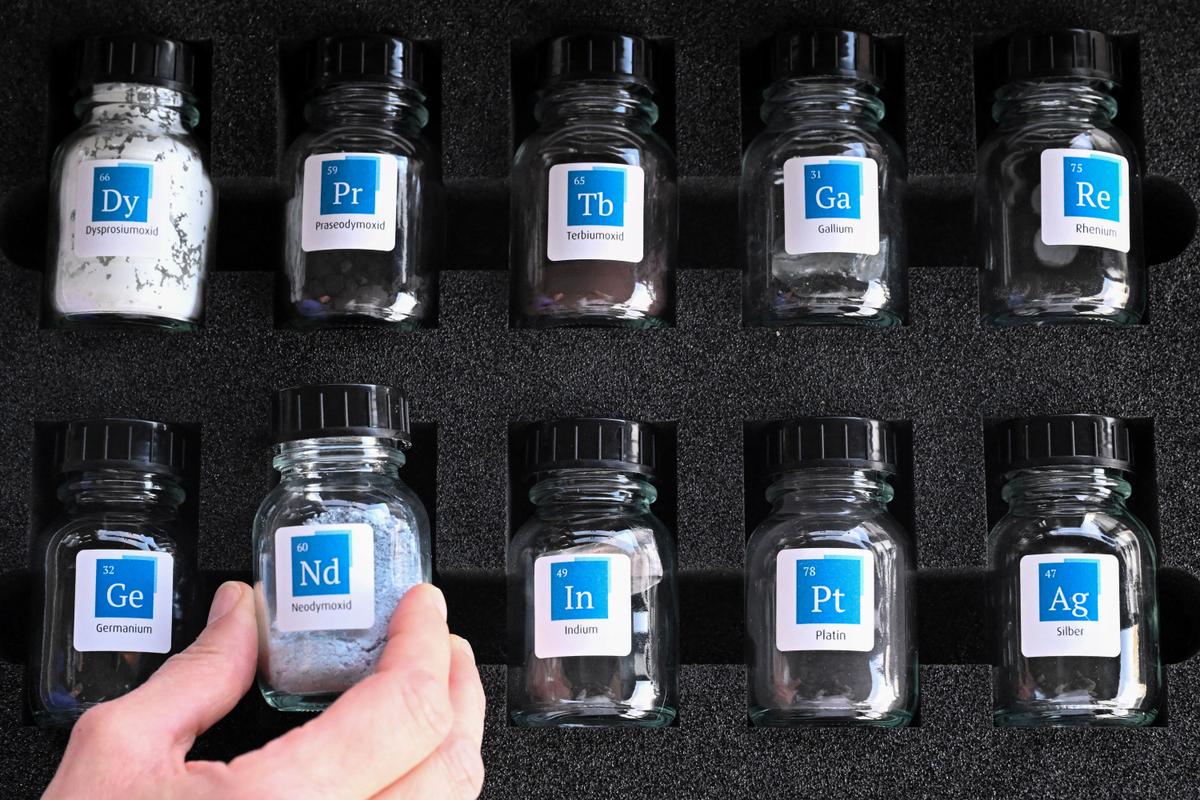
Glass jars containing rare earths are pictured inside the storage room of Tradium, a company specialised in trading rare earths, in Frankfurt am Main, western Germany, on Nov. 4, 2025. Kirill Kudryavtsev/AFP via Getty Images
Companies turning raw critical minerals into finished chemicals and advanced materials have warned a parliamentary inquiry that Australia risks falling short of its critical minerals goals without greater government support.
The House Standing Committee on Primary Industries is examining social licence and economic development in critical minerals projects across Australia.
Robert Williamson, managing director of Alpha HPA, told the committee about the value his Gladstone plant adds to raw materials. The company refines alumina hydrate into high-purity alumina used in semiconductors and batteries.
“We take feedstock worth about US$400 ($574) a tonne and sell it for over US$30,000 a tonne,” he said.
While Williamson said government funding was needed to build confidence among international partners and private-sector businesses, he said the pace of funding was not keeping up with the rapid development of these technologies.
“The pace at which funding can unlock these opportunities is too slow,” he said.
“Australia competes directly with jurisdictions that offer coordinated policy, streamlined approvals, and substantial financial incentives. So we must be competitive on these fronts as well.”
Patrick Hastings, CEO of the Gladstone Engineering Alliance, said shared infrastructure was another gap, with funding caught in “a no man’s land” between federal, state and local governments and industry.
He also pointed to duplicated approvals, with companies repeating the same studies for state and federal regulators.
Grenof, a chemical manufacturer, is building a chlor-alkali plant in the Gladstone State Development Area called Project Halogen, in which the Queensland Investment Corporation holds a 50 percent stake.
Managing Director Scott Barnes described his industry as “adjacent” to critical minerals, supplying reagents without which the sector cannot process ore.
Fellow Director Jason Brooks asked the committee for the same fast-tracked approvals and financial support given to critical minerals projects.
“We'd probably like to be seen as quite critical to the critical mineral processes as well,” he said.
In its submission (pdf), Grenof said it is seeking finance through the Northern Australia Infrastructure Facility (NAIF), the National Reconstruction Fund and Export Finance Australia.
The National Reconstruction Fund has a $1 billion (US$700 million) investment target for value-adding in resources within its $15 billion allocation, while NAIF has earmarked an additional $500 million for critical minerals projects.
“Extracting the resources is only the beginning,” Barnes told the committee. “If we want economic, strategic, and sovereign benefits to remain onshore, we need the infrastructure, the people, the cross-sector chemical manufacturing capabilities that allow these resources to be processed here in Australia.”








 English (US) ·
  Turkish (TR) ·