
China is surveying waters near Japan’s southwestern islands to prepare for a possible war over Taiwan, leaving Tokyo little chance of escaping the conflict, experts warn.
The Xiang Yang Hong 22—a Chinese oceanographic research vessel—conducted five surveys in Japan’s exclusive economic zone (EEZ) west of the Senkaku Islands between March and July, according to a Sept. 26 Kyodo News analysis of automatic identification system (AIS) data.
The disputed Senkaku Islands in the East China Sea are administered by Japan and claimed by Beijing, which calls them the Diaoyu Islands.
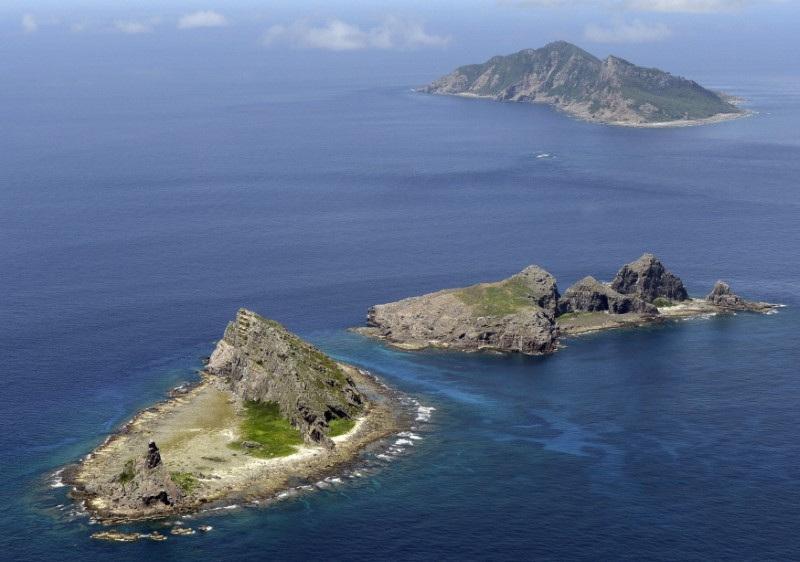
A group of disputed islands, Uotsuri (R), Minamikojima (L), and Kitakojima (C), known as Senkaku in Japan and Diaoyu in China, in the East China Sea, in September 2012. Kyodo/Reuters
The report, citing Japanese Defense Ministry sources, said the surveys could be part of China’s preparation for a possible invasion of Taiwan—a self-governed democracy that the Chinese Communist Party (CCP) has never controlled but has vowed to
annexby force.
The Epoch Times could not independently verify the findings.
China’s Foreign Ministry and the East China Sea Bureau of the Ministry of Natural Resources, which operates the vessel, had not responded by publication time to Epoch Times requests to confirm that the surveys took place.
As of Sept. 19, the Japanese coast guard had recorded 13 cases in 2026 of Chinese research vessels conducting unauthorized surveys in waters around Japan, up from six in all of 2025.
In July, a Chinese coast guard ship demanded that Japanese coast guard survey ships stop their work near the Senkakus, prompting a protest from Tokyo.
Japan–China relations have soured since Japanese Prime Minister Sanae Takaichi
saidin November 2025 that her country would be justified in activating its Self-Defense Forces if Taiwan were attacked.
The Chinese regime responded with a string of military provocations, including repeated coast guard
incursionsnear the Senkakus, and
economic coercion.
Same Theater
Shen Ming-shih, a researcher at Taiwan’s Institute for National Defense and Security Research, said that intensive Chinese survey work and military activity suggest Taiwan and the waters around the Senkakus—which lie to its northeast—are being treated as part of the same theater.

Taken during a media tour organized by the Chinese People's Liberation Army Navy (PLAN), this photo shows two submarines at the PLA Naval Museum in Qingdao, Shandong Province, China, on April 23, 2024. Wang Zhao/AFP via Getty Images
“This means Japan would struggle to stay out of a conflict in the Taiwan Strait, since its southwestern islands would likely be drawn in,” Shen told The Epoch Times.
Shen said that should Beijing attack Taiwan, control of the seas and skies around the Senkakus could effectively cut off U.S. and Japanese reinforcements heading south from Okinawa and mainland Japan.
“China’s research ships, coast guard vessels, and drones there are collecting the ocean data its submarines need to set ambushes and enforce a blockade,” he said.
“It all fits into integrated preparations for a war over Taiwan.”
Lin Ting-hui, former deputy secretary-general of the Taiwan Society of International Law, said Beijing’s actions justify Tokyo’s
established stancethat “a Taiwan emergency is a Japanese emergency,” and a conflict could force Washington to step in.
“If China ever dares to use force, the shock waves will be felt far beyond Taiwan, from the United States to the rest of the world,” Lin told The Epoch Times.
“Once Beijing moves against Taiwan, it will likely weigh whether it can take the Senkakus too, though it will need to be fully confident of success before acting.”
Stephen Nagy, a professor of politics and international studies at Tokyo’s International Christian University, told The Epoch Times that Japan may wish to avoid conflict, but “geography severely limits neutrality.”
Blockading Taiwan
Nagy said the surveys could help the People’s Liberation Army (PLA) understand operational conditions northeast of Taiwan, especially for missions to block, divert, or intercept opposing forces.

A new type 094A Jin-class nuclear submarine Long March 10 of the Chinese People's Liberation Army Navy near Qingdao, in Shandong Province, China, on April 23, 2019. Mark Schiefelbein/AFP via Getty Images
“Oceanographic data—bathymetry, currents, seabed composition, temperature layers—can support submarine routing, anti-submarine warfare, mine planning, and amphibious operations,” he said.
Lin said that the Xiang Yang Hong 22 is clearly on a military mission that Beijing passes off as “routine marine scientific research.”
“The Taiwan Strait is mostly less than 328 feet (100 meters) deep, which makes it hard for submarines to hide,” he said.
“Near the Senkakus, the Okinawa Trough is nearly 6,562 feet (2,000 meters) deep, but its currents make hiding submarines risky. The ship is studying the waters for future naval operations.”
Lin said that in the East China Sea, China is implementing its anti-access/area-denial (A2/AD) strategy, which aims to keep rival forces from reaching a battle zone rather than confront them head-on.
Threatening Japan
Nagy said the CCP exploits the blurred line between lawful research, coercive signaling, and military preparation, leaving Japan, Taiwan, and the Philippines in a bind.

A Chinese coast guard vessel (R) fires its water cannon at the Philippine BRP Datu Pagbuaya near Philippine-occupied Thitu Island in the South China Sea on Oct. 12, 2025. Philippine Coast Guard via AP
“China’s research vessels are best understood as dual-use platforms: formally civilian, but potentially feeding military planning,” he said.
“This ambiguity complicates responses.”





 English (US) ·
  Turkish (TR) ·