
 2 hours ago
27
During a recent Bible study service in the Río de Janeiro neighbourhood of Vila Isabel, the congregation recited a prayer about God and being faithful.
Regina da Silva Andrade, 38, one of the congregants, said that while she believed God was in charge of the universe, Brazil's elected officials had a duty to care for the country's citizens.
"We have ... expectations that our country’s leadership would be concerned with meeting essential needs — such as health care and education —and that, at the very least, these areas would be properly cared for," she said.
Still undecided about who to vote for, Andrade said she was leaning toward Flávio Bolsonaro, the 45 year-old senator son of Jair Bolsonaro, the former Brazilian president convicted of plotting a coup after he lost the 2022 election to Luiz Inácio Lula da Silva.
WATCH | Jair Bolsonaro's son now running for president: Brazil's former president gets 27 years for plotting a coup in 2022 | Hanomansing Tonight
Andrade said Flávio Bolsonaro was a better candidate than his father.
"Bolsonaro … may waver between one extreme and the other at times, but I see a genuine interest on his part in finding balance," she said.
"I don't know if he'll succeed, but I'm not particularly concerned — his father engaged in corruption to the point of ending up in prison."

Regina da Silva Andrade, 38, centre, said that while she believed God was in charge of the universe, Brazil's elected officials had a duty to care for the country's citizens. (Douglas Engle/CBC)
Presidential race 'never this close,' journalist says
Flávio Bolsonaro — campaigning on tax cuts, a hard line on crime and family values — emerged from the first round of voting on Oct. 4 in Brazil's presidential election with about 2.2 million more votes than Lula, the 80-year-old incumbent.
Recent polls have shown the race between the two candidates tightening.
"It's really a toss of a coin," said Pedro Doria, editor of MEIO media group in Río de Janeiro.
Still, Doria said no presidential candidate who came in second after the first round of voting has ever won an election since 1989 — when the current electoral system was put in place.
"But it was never this close. Flávio's difference against Lula was 1.9 percentile points. This is basically nothing."
Doria said that the Brazilian population is heavily polarized, and some voters are more motivated to vote against a candidate than in support of someone they believe in.
"A third of Lula's voters are not voting for Lula, they are voting against Bolsonaro," said Doria. "Half of Senator Flávio Bolsonaro's voters are voting against Lula, not for Flávio."

Marsílea Gombata, a researcher with the University of Sao Paulo's Centre for International Relations Research, said frustrations around corruption and feelings of personal financial stagnation have driven many voters to cast ballots for Bolsonaro. (Courtesy of Marsílea Gombata)
Marsílea Gombata, a researcher with the University of Sao Paulo's Centre for International Relations Research, said frustrations around corruption and feelings of personal financial stagnation have driven many voters to cast ballots for Bolsonaro despite the actions of his father and the candidate's own record of controversy.
Bolsonaro has in the past been tied to paramilitary groups — he praised them in a two decade-old speech while a state deputy, and his office once employed the mother and wife of the founder of a paramilitary group linked to the killing of a human rights activist.
Bolsonaro's father's coup-plotting conviction — which included allegations there were plans to assassinate Lula — and subsequent 27-year sentence has had limited impact on Flávio Bolsonaro's support, said Gombata.
"We can see that it doesn't matter to people."
While Lula, who previously served two presidential terms between 2003 and 2011, strengthened and reintroduced social programs in his last term to help the poor such as Bolsa Familia, which provides conditional direct cash transfers to families, a large swath of the population has felt left out, said Gombata.
The lower middle class, where many work a second job in the gig economy, has felt "betrayed" by Lula's promises of prosperity that, they believe, never materialized for them.
"They were hoping for a better life, for their children, but it didn't happen and today life is more difficult," said Gombata.
Bolsonaro's promises of tax cuts for fuel, electricity and transport, as well as reductions in government spending appeals to this segment of the population, she said.

Paulo Coelho, who runs the Cavacas Sporting Goods store in Río de Janeiro, 64, said he’s voting on the economy Sunday and his ballot will go to Bolsonaro. (Douglas Engle/CBC)
The 2014 Operation Carwash investigation, which ensnared several top officials in Lula's Workers Party and Lula himself — until the Supreme Court overturned his corruption-related conviction in 2021 — still casts a long shadow, Gombata said.
"We are still living those consequences … the theme of corruption is a big one."
Both candidates facing corruption probes
Bolsonaro has been side-swiped during the election campaign by his own corruption allegations.
It recently emerged that Bolsonaro requested and received millions of dollars for a documentary about Jair Bolosonaro from a key player in a major bank fraud case. Flávio is also under investigation in relation to the case.
However, Lula has faced his own troubles. His son is under a separate influence peddling and corruption probe ordered by the Supreme Court, Reuters reported.
Paulo Coelho, 64, who runs the Cavacas Sporting Goods store in Río de Janeiro, said he’s voting on the economy Sunday and his ballot will go to Bolsonaro.
"Everyone is worried about slowing economic activity in Brazil," he said.
"Flávio Bolsonaro has an economic plan and vision that I am more aligned with."
The Brazil election's U.S. factor
Aline Vieria, 38, who runs a community dance program for women, said she's voting for Lula because she worries a Bolsonaro government will sever the social safety nets that have kept many people from misery.
"I have three children, ages 15, 11 and five, and I don’t want to jeopardize their future," she said.
"There is a real risk to our population given the stances they've taken on social issues."

Aline Vieria, 38, who runs a community dance program for women, said she's voting for Lula because she worries that a Bolsonaro government will lead to a severing of social safety nets. (Douglas Engel/CBC)
Solange Marquez, vice-president of policy with the Canadian Council for the Americas, says Sunday's results could impact Brazil's relationship with the United States.
The close relationship between the Bolsonaro family — Flávio is one of three brothers — and the U.S. administration of Donald Trump could lead to an escalation of U.S. military involvement in South America through boots on the ground in Brazil in joint security operations against armed drug trafficking groups, said Marquez.
"I think [Flávio] Bolsonaro is eager to open the door to Donald Trump in exchange for a better economic, commercial relationship with Washington."
WATCH | From last summer: Trump weighs in: Trump threatens 50% tariff on Brazil over Bolsonaro trial 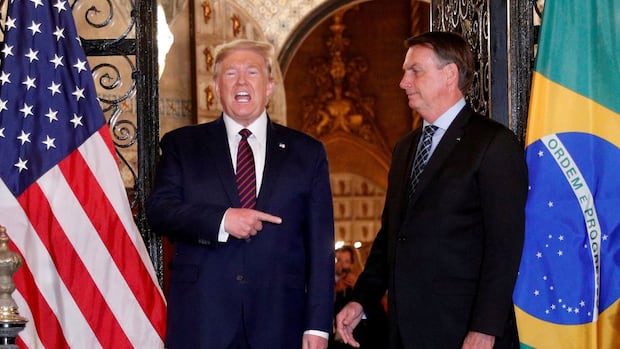
U.S. boots on Brazilian soil is something that worries retiree Carlos Vitor, 65, who voted twice for the elder Bolsonaro. This time, he says, he's voting for Lula.
"I’m afraid that the United States might invade Brazil because of the drug traffickers," he said.
Vitor said a Flávio win will magnify the deep divisions that currently exist within the country and possibly lead to violence.
"The left, they're going to fight. If Flávio wins, they're going to fight," he said.
"Will this place turn into a civil war? For sure."







 English (US) ·
 Turkish (TR) ·
